Table of Contents
But as we navigate the digital landscape of 2025, the definition of a “good” website has fundamentally shifted. It is no longer enough to simply exist online. To succeed, a modern business must compete on performance, mobile responsiveness, accessibility compliance, and sophisticated search engine visibility.
In this comprehensive, deep-dive review, we will move far beyond surface-level marketing claims. We will dissect the technical reality of GoDaddy’s “Websites + Marketing” platform, exploring the implications of its section-based editor, its proprietary hosting infrastructure, and its long-term scalability limitations. Crucially, we will contrast these capabilities with the industry standard for professional growth: the open ecosystem of WordPress and the Elementor Website Builder Platform.
This article is designed for the serious business owner, marketer, or creator who views their website not as a digital checkbox, but as a primary asset for revenue and brand equity. By the end, you will understand exactly what you are buying when you choose GoDaddy, and why the “Managed Freedom” of a more robust platform is often the smarter long-term investment.
Key Takeaways
- Speed vs. Control: GoDaddy utilizes a rigid, section-based editor that prioritizes speed (launch in 30 minutes) over flexibility. While fast, it sacrifices pixel-perfect design control, making it difficult to create a unique brand identity.
- The “Rented Land” Liability: Building on GoDaddy’s proprietary platform creates “vendor lock-in.” You cannot move your website code to another host. In contrast, open platforms like WordPress offer full data portability and ownership.
- SEO Limitations: GoDaddy provides basic SEO wizards suitable for low-competition keywords but lacks the technical depth (custom Schema, URL slug control, advanced sitemaps) required to rank for competitive search terms.
- eCommerce Ceilings: The GoDaddy store is functional for simple catalogs but hits a “feature ceiling” with complex needs like B2B pricing or custom checkout flows, areas where the WooCommerce Builder excels.
- Performance Trade-offs: Proprietary builders often suffer from “code bloat” (excessive JavaScript) which impacts Core Web Vitals. Specialized environments like Elementor Hosting leverage Google Cloud and Cloudflare Enterprise for superior speed.
- Cost of Ownership: While introductory prices are attractive, high renewal rates and the cost of essential add-ons often make the Total Cost of Ownership (TCO) higher than professional managed WordPress solutions.
Chapter 1: The Promise of Speed vs. The Reality of Control
To truly evaluate GoDaddy, we must first analyze the philosophy behind its software design. GoDaddy’s “Websites + Marketing” product is built on a single premise: friction reduction. Every decision in the interface is made to prevent the user from making a mistake. However, in design, preventing mistakes often means preventing creativity.
The “Airo” Experience: Automating Average
In 2025, GoDaddy leans heavily on Airo, its AI-assisted onboarding flow. When you sign up, Airo asks a few questions about your business category and name. Within seconds, it generates a complete site populated with stock photography and generic, AI-generated copy.
For a user with zero design experience or technical interest, this is a “magic moment.” It provides an immediate sense of accomplishment. You have a site. It exists.
However, the limitation becomes apparent the moment you try to deviate from the AI’s suggestion. Airo is a generator, not a collaborator. It builds a box for you, but it doesn’t give you the tools to expand that box. It solves the “Blank Page Problem” by filling the page with generic content that, while functional, rarely captures the nuance of a specific brand voice.
The Professional Alternative: Context-Aware AI
Contrast this with the approach of the Elementor AI Site Planner. In a professional workflow, AI isn’t used to replace your judgment; it is used to augment your strategy.
- Strategic Blueprinting: Instead of just spitting out a site, the AI Site Planner helps you generate a sitemap, wireframes, and a structural brief. It treats you as the architect.
- Contextual Assistance: Once inside the editor, Elementor AI acts as a co-pilot. If you are building a “Call to Action” section, it understands that context and suggests punchy, conversion-focused copy. If you need a specific visual style, it can generate unique images or custom CSS code to achieve a look that no template can offer.
- The Difference: GoDaddy’s AI says, “I’ll do it for you.” Elementor’s AI says, “I’ll help you do it better.”
The Section-Based Editor: A Golden Cage
GoDaddy uses a “Section-Based Editor.” This is distinct from a true “Drag-and-Drop” editor, although marketing materials often blur the lines.
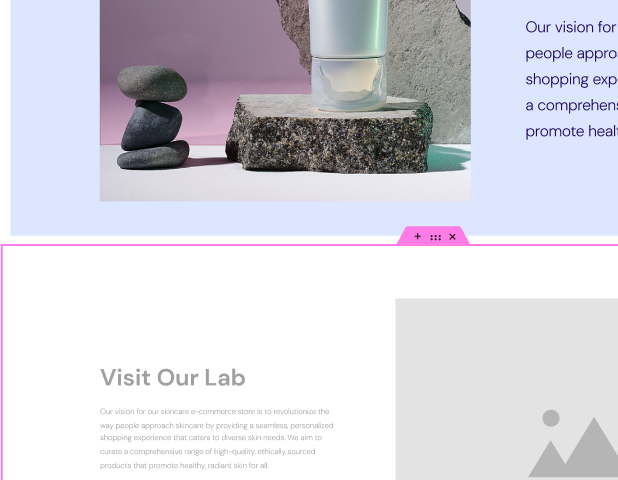
In GoDaddy, you build a page by stacking horizontal strips (sections) on top of each other.
- Select: You click “Add Section.”
- Choose: You pick from a pre-set menu (e.g., “About,” “Photo Gallery,” “Contact”).
- Variation: You select one of 5-10 pre-designed layout variations for that section.
- Fill: You type your text into the provided fields.
The Consequence of Rigidity
This system is “unbreakable,” which is its primary selling point. You cannot accidentally mess up the mobile view because the system doesn’t let you change it. But this safety comes at a high cost: Sameness.
- If you want to move a button from the left side of a text block to the center, you can only do so if there is a pre-made layout that supports it.
- If you want to overlap an image with a text box to create a modern, dynamic look, you cannot.
- If you want to change the padding between two specific elements to create “breathing room,” you are often restricted to global spacing settings.
The Elementor Alternative: The Creative Engine
For those who refuse to compromise on brand identity, the Elementor Website Builder operates on a “Pixel-Perfect” philosophy. Using advanced web technologies like Flexbox Containers and CSS Grid, it gives you absolute control over the canvas.
- Fluid Design: You can set elements to grow, shrink, or stack based on precise screen sizes. You are not limited to “Desktop” and “Mobile”; you can design for ultrawide monitors, laptops, tablets, and distinct mobile sizes.
- Dynamic Positioning: You can fix a “Call to Action” button to the bottom of the screen so it follows the user as they scroll, increasing conversion rates. You can use “Absolute Positioning” to place a badge (“Best Seller”) exactly on the corner of an image.
- Motion Effects: Unlike GoDaddy’s static pages, Elementor allows for professional interaction design. You can add subtle entrance animations, mouse-track effects, or parallax scrolling that adds a premium, tactile feel to the user experience.
This is the fundamental difference: GoDaddy is filling out a form that generates a webpage. Elementor is painting on a canvas that becomes a digital experience.
Chapter 2: The “Rented Land” Problem (Ownership & Portability)
Perhaps the most critical business factor in this review—and one often ignored until it is too late—is the concept of Digital Asset Ownership.
Proprietary Software: The Rental Trap
GoDaddy “Websites + Marketing” is a proprietary SaaS (Software as a Service) product. The code that renders your website, the templates you use, and the backend logic all belong to GoDaddy. You are effectively renting the technology stack.
The Implication of Vendor Lock-In:
- No Export Button: If you outgrow GoDaddy—perhaps you need a feature they don’t offer, or you are unhappy with a price hike—you cannot take your website with you. There is no export function.
- The Migration Nightmare: To leave GoDaddy, you must engage in a manual destruction process. You have to open every page of your site, copy the text into a Word document, download every image one by one, and then rebuild the entire site from scratch on a new platform. You lose your design, your SEO settings, and your data structure.
The WordPress & Elementor Model: Asset Ownership
Elementor is built on WordPress, the open-source software that powers over 40% of the web. This distinction is vital for business valuation.
- Data Portability: With WordPress, the content (posts, pages, products) and the database belong to you. You can export an XML file of your entire site’s content at any time.
- Hosting Independence: While Elementor Hosting provides a highly optimized environment for the platform, you are never “locked” to it. If you choose to move your site to a different server architecture, you can use a migration plugin to package the entire site—design, plugins, database, and all—and move it.
Why This Matters for Valuation: If you ever plan to sell your business, a potential buyer will conduct “Technical Due Diligence.” A website built on “rented land” (GoDaddy) is often viewed as a liability because it is tied to a specific vendor’s constraints. A website built on open standards (WordPress) is an owned asset that can be transferred, audited, and modified without restriction.
Chapter 3: Design, Responsiveness, and Brand Identity
In 2025, design is trust. Users make a subconscious judgment about a business’s credibility within 50 milliseconds of the page loading. A generic design signals a generic business. A bespoke design signals a premium brand.
The Theme Limitation: “Looks” vs. “Design Systems”
GoDaddy does not have “Themes” in the traditional WordPress sense. It has “Looks.” A “Look” is essentially a global configuration of font pairings and a color palette.
- Fonts: You are limited to a curated list of fonts. You cannot upload a custom font file (e.g., a specific brand font you purchased for your logo) without using “HTML embed” workarounds that often break the site’s styling.
- Colors: You set a primary and secondary color. The system then automatically applies these to buttons and accents. You lack the granular control to say, “I want this specific button to be green for conversion, but all other buttons to be blue for navigation.”
Mobile Responsiveness: The Black Box
GoDaddy sites are responsive, meaning they adapt to mobile screens automatically. This is a massive benefit for beginners who might otherwise “break” a site. However, it is a “Black Box” system—you cannot see or change how the decision is made.
- Scenario: You have a beautiful, wide hero image of your team. On desktop, it conveys trust. On mobile, the system automatically centers and crops the image. Now, the text overlay is covering your CEO’s face, or the key product in the background is cut off.
- GoDaddy Solution: You often have to choose a generic, abstract image that “works everywhere,” compromising the impact of your desktop design.
The Elementor Solution: Responsive Mode
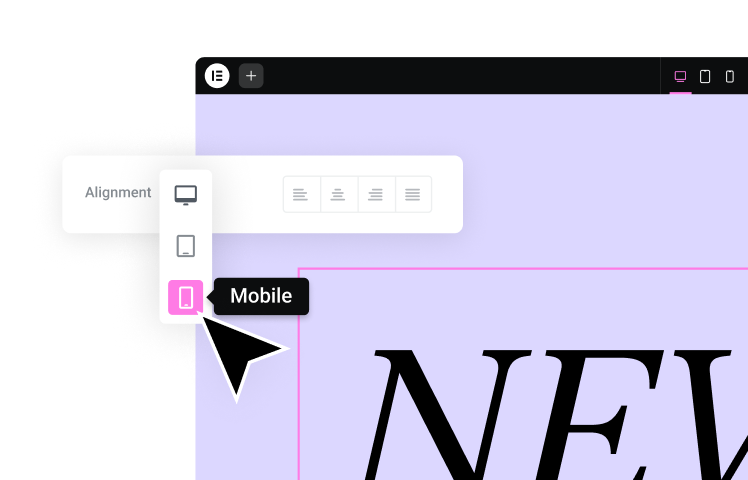
Professional creators demand control over every breakpoint. Elementor provides a “Responsive Mode” that allows you to toggle between Desktop, Tablet, and Mobile views while editing.
- Device-Specific Content: You can choose to show a complex, interactive chart on Desktop, but hide it and show a simplified summary list on Mobile.
- Focal Point Control: You can adjust the position of background images specifically for mobile to ensure faces are never covered.
- Typography Scaling: You can set your headline to be 60px on Desktop for impact, but scale it down to 30px on Mobile for readability, ensuring no awkward line breaks.
This level of detail ensures the user experience is optimized, not just adapted.
The “Hello Theme” Advantage
For those building a brand from scratch, the Hello Theme is a critical asset in the Elementor ecosystem. It is a lightweight framework designed to act as a blank canvas. Unlike GoDaddy’s templates which come with “opinionated” styling that you have to fight against, Hello Theme creates a neutral foundation. You then build your own Global Design System within Elementor—defining your exact brand colors, typography hierarchy, and button styles—which ensures consistency across 10, 100, or 1000 pages.
Chapter 4: The Performance & Technical Ceiling
Speed is a feature. Since the introduction of Google’s Core Web Vitals, loading speed, interactivity, and visual stability have become direct ranking factors.
The Bloat of Proprietary Builders
To make their editors “easy” and “crash-proof,” proprietary builders like GoDaddy load a significant amount of JavaScript code in the background. This code controls the drag-and-drop interface, the analytics tracking, the marketing pop-ups, and the layout engine. Even if you publish a simple page with just three paragraphs of text, the browser has to download and parse this massive library of code.
- Impact on LCP (Largest Contentful Paint): The heavy code delays the rendering of the main image or text.
- Impact on INP (Interaction to Next Paint): The browser is so busy executing GoDaddy’s scripts that it may lag when a user clicks a button.
Crucially, you cannot fix this. You have no access to the server configuration or the source code. You cannot install a caching plugin. You cannot defer JavaScript execution. You are stuck with the performance the platform provides.
The “Optimized Foundation” of Elementor Hosting
Performance is a core pillar of the Elementor Ecosystem. By decoupling the hosting from the software, Elementor allows for enterprise-grade optimization.
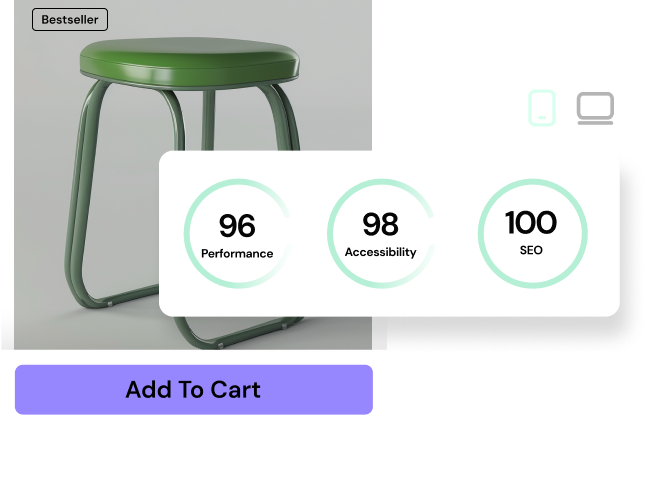
- Google Cloud Platform (C2 Machines): Elementor Hosting runs on Google’s top-tier infrastructure, specifically their C2 (Compute-Optimized) virtual machines. These provide faster server response times (TTFB) than GoDaddy’s standard shared hosting clusters.
- Cloudflare Enterprise CDN: Included natively, this distributes your content to hundreds of edge servers worldwide. A visitor in London loads your site from a London server, not one in Arizona, reducing latency.
- Image Optimizer by Elementor: Large images are the #1 cause of slow sites. The Image Optimizer plugin automatically compresses media and converts it to modern formats like WebP and AVIF. This happens in the background, ensuring your site remains fast without you needing to be a compression expert.
This architecture ensures that your website can scale. Whether you have 100 visitors or 100,000, the infrastructure is designed to handle the load without the “code bloat” limitations of a closed builder.
Chapter 5: SEO Capabilities – The Invisible Ceiling
Search Engine Optimization (SEO) is the art of speaking to Google. GoDaddy teaches you the alphabet; WordPress lets you write poetry.
The “SEO Wizard” vs. Technical Control
GoDaddy’s “SEO Wizard” is a user-friendly tool designed for beginners. It asks you what your business is, suggests some keywords, and helps you inject them into your Page Title and Meta Description. For a local bakery wanting to show up for “cupcakes near me,” this is functional and often sufficient.
However, competitive SEO requires technical control that GoDaddy often hides or blocks to keep the interface simple:
- URL Slugs: In GoDaddy, blog post URLs are often auto-generated based on the title. If you change the title later, the URL might change, breaking backlinks. In WordPress, you have total control over the “slug” (the part of the URL after the domain) to make it keyword-rich, concise, and permanent.
- Schema Markup: Schema is the code that tells Google “This is a recipe,” “This is a product,” or “This is an event.” It is the key to getting rich snippets (stars, pricing, images) in search results. GoDaddy has very limited native schema support. In Elementor, you can inject custom schema JSON-LD scripts or use dedicated SEO plugins (like Yoast SEO or RankMath) to manage this granularly.
- Sitemaps and Robots.txt: GoDaddy generates these automatically. You cannot edit them to tell Google not to index a specific administrative page or to prioritize a landing page.
The “Content Silo” Issue
Modern SEO is driven by content strategy—creating clusters of related content (Hub and Spoke models). GoDaddy’s blogging platform is incredibly rigid. It allows for text and images, but you cannot easily create custom internal linking structures.
With Elementor Pro, you can use the Theme Builder to design a “Single Post Template.”
- Dynamic Injection: You can create a layout where every blog post automatically includes a “Related Products” widget based on the post’s category.
- Sticky Table of Contents: You can add a navigation rail that stays with the user as they read long-form content, improving “Time on Page” metrics.
- Custom Call to Action: You can inject a newsletter signup form in the middle of every post without editing them individually. This capability turns a blog from a diary into a lead-generation engine.
Chapter 6: eCommerce & Marketing
Selling online is high stakes. A friction-filled checkout process or a confusing product page costs money every single hour.
GoDaddy Store: The “Retail” Solution
GoDaddy’s eCommerce plan is a solid, turnkey solution for standard retail. If you sell t-shirts, candles, or pre-packaged food, it works well. It tracks inventory, calculates shipping (via integrations), and accepts payments. The Limit: It is a closed loop.
- Checkout: You cannot customize the checkout page. If you want to add a “Gift Message” field, a “Tip Your Driver” option, or a custom “Terms and Conditions” checkbox, you generally can’t.
- Payment Gateways: You are nudged heavily toward GoDaddy Payments. While they support major options like PayPal, if you need a specific local gateway for a country GoDaddy doesn’t prioritize, or a high-risk processor, you are out of luck.
Elementor + WooCommerce: The “Scale” Solution
Elementor integrates deeply with WooCommerce, the most popular eCommerce software on the planet. This combination removes the ceiling on what you can sell and how you sell it.
- The WooCommerce Builder: This feature in Elementor Pro allows you to visually design every part of the shopping experience. You are not stuck with a default “Product Page.” You can build a custom layout that emphasizes video reviews for a tech product, or large imagery for a fashion product.
- Custom Cart & Checkout: You can redesign the Cart and Checkout pages to reduce friction. You can remove unnecessary fields, add trust badges (security logos) near the “Pay” button, or create a distraction-free checkout flow that removes the header and footer.
- Extensibility:
- Need to sell subscriptions? Install the WooCommerce Subscriptions plugin.
- Need to sell booking slots? Install a booking plugin.
- Need dynamic pricing (e.g., “Buy 5, get 10% off”)? There’s a plugin for that.
- Need to hide prices for B2B customers until they log in? Easy to implement.
This modularity ensures that you never hit a “feature ceiling.” You can start simple and add complexity only when your revenue supports it.
Marketing Tools: Integration vs. Isolation
GoDaddy bundles email marketing and “GoDaddy Studio” (a Canva-like tool) into its dashboard. This is convenient for simple newsletters. However, the data remains siloed within GoDaddy.
Elementor’s approach is Native Integration.
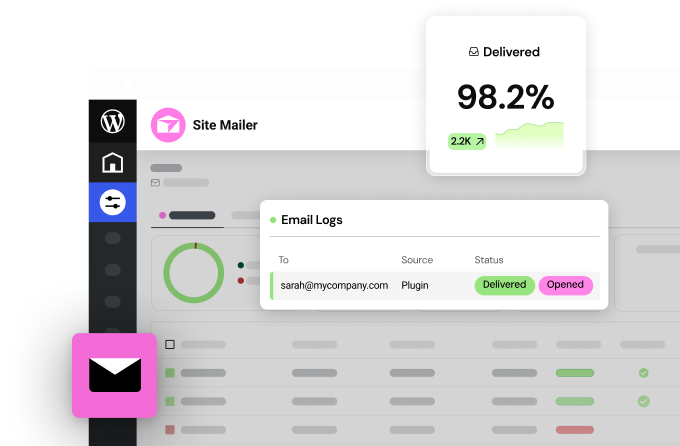
- Site Mailer: One of the biggest issues with WordPress can be email deliverability (receipts going to spam). Site Mailer solves this by authenticating your domain and bypassing the unreliable default PHP mail function, ensuring your transactional emails actually arrive.
- Send by Elementor: This is a comprehensive marketing platform integrated directly into your website. Because it lives in your ecosystem, it can trigger complex automations based on user behavior on your site (e.g., “User visited the Pricing page 3 times but didn’t buy -> Send discount email”).
- Form Builder: Elementor’s native form builder connects to virtually every CRM (HubSpot, Mailchimp, Salesforce, ActiveCampaign) via webhook or direct integration, giving you the freedom to choose the best marketing stack for your business.
Chapter 7: Accessibility and Inclusivity
In 2025, web accessibility (ensuring your site works for people with disabilities) is not just a moral obligation; it is a legal one. Lawsuits regarding ADA compliance and the European Accessibility Act (EAA) are on the rise.
GoDaddy’s Approach
GoDaddy sites are generally built with standard code, but ensuring compliance is largely manual. They do not offer deep, native scanning tools to tell you if your color contrast is too low or if your navigation is keyboard-accessible. You often have to rely on third-party “overlay” widgets, which many accessibility advocates argue do not solve the underlying code issues and can sometimes make the experience worse.
The Elementor Solution: Ally
Elementor has taken a proactive stance with Ally by Elementor. This is a native tool designed to help creators build inclusive websites from the ground up.
- Automated Scanning: It scans your site for common accessibility violations (like missing Alt Text on images or poor contrast ratios).
- Remediation: It doesn’t just flag issues; it helps you fix them within the editor.
- Compliance: It helps you generate an accessibility statement, a requirement for many regulations. By integrating this into the workflow, Elementor helps protect your business from legal risk while ensuring you reach the widest possible audience.
Chapter 8: The Developer & Agency Ecosystem
If you are a solo business owner, you might think “I don’t need developer tools.” But one day, you might hire an agency to help you grow.
The GoDaddy Ceiling for Pros
Agencies generally dislike working on GoDaddy “Websites + Marketing” because their hands are tied. If you ask an agency, “Can you add a custom calculator to my site?” or “Can you make the menu do this specific animation?”, they have to tell you “No, the platform doesn’t support that.” This leads to a painful “Replatforming” conversation where the agency tells you that to achieve your goals, you need to scrap your GoDaddy site and move to WordPress.
The Elementor Professional Workflow
Elementor is built with agencies and developers in mind.
- Role Manager: You can give a client access to the editor but lock them out of the “Design” tab. They can change the text and images, but they cannot accidentally drag a button 50 pixels to the left and break the layout.
- Notes: Teams can leave comments directly on the visual interface (“Make this logo bigger,” “Change this copy”). This streamlines the feedback loop.
- Finder: A powerful search tool within the editor that lets you jump between pages and settings instantly, speeding up workflow.
- Custom Code: Developers can inject custom CSS, JavaScript, or PHP to achieve functionality that isn’t native. There is no ceiling.
Chapter 9: Pricing & Value (The True Math)
GoDaddy is famous for its Super Bowl ads and its aggressive introductory pricing. But businesses run on P&L (Profit and Loss) statements, not introductory offers.
The “First Year” Trap
GoDaddy often advertises a very low monthly rate (e.g., $9.99/mo) for the first term. However, you must look at the Renewal Price.
- Renewal Shock: The price often jumps by 50% to 100% after the first year.
- The Add-on Stack: Features that are standard in the open-source world often come with a price tag in the “Walled Garden.”
- Domain Privacy: Often an upsell.
- Professional Email: Often free for 1 year, then a monthly fee per inbox.
- Appointment Booking: Requires a higher tier plan.
- Marketing Tools: The “Basic” plan includes very little; you must upgrade to “Premium” for meaningful marketing quotas.
The Elementor Value Proposition
When you look at Elementor Hosting, you are buying a bundle:
- Managed Cloud Hosting: (Comparable standalone value: $30/mo)
- Elementor Pro Builder: (Comparable standalone value: $10/mo)
- Enterprise CDN & Security: (Comparable standalone value: $20/mo)
- Premium Support: Included.
When you do the math over a 3-year period—the typical lifecycle of a website design—the “Premium” DIY solution (Elementor) often comes out cheaper or comparable to the “Cheap” solution (GoDaddy) once you factor in the renewal hikes and necessary add-ons.
And critically, with Elementor, you are investing in an asset you own. You are building equity in your digital presence, not just paying rent.
Chapter 10: The Verdict – Who is it for?
Is GoDaddy a good website builder? The answer depends entirely on your timeline, your ambition, and your definition of “good.”
The Case for GoDaddy
If you fit these specific criteria, GoDaddy is a valid, functional choice:
- The “One-Week Project”: You need a website for a family reunion, a wedding info page, or a temporary local event. It needs to look clean, work on mobile, and be up tonight.
- The “Proof of Concept”: You have a business idea and just need a landing page to see if anyone clicks your ads. You don’t care about SEO, brand identity, or scaling yet. You just need “existence.”
- The “Non-Digital” Business: You are a local service provider (e.g., a plumber or dry cleaner) with no desire to grow online. You just need a digital business card so people can find your phone number on Google Maps.
For these users, the friction of learning a professional tool is unnecessary. GoDaddy solves the problem of “existence” faster than anyone.
The Case for Elementor
If you fit these criteria, Elementor is the necessary choice:
- The Brand Builder: You care about aesthetics. You want your website to evoke a specific feeling that matches your physical product or service.
- The Growth Marketer: You need to track conversions, use ad pixels, run A/B tests, and optimize for long-tail SEO keywords.
- The eCommerce Entrepreneur: You plan to expand your product line, offer bundles, or create a unique shopping experience.
- The Long-Term Thinker: You want to own your data. You want to ensure that if your business grows 10x next year, your website won’t have to be thrown in the trash and rebuilt.
Elementor is not just a tool; it is a platform. It is a professional environment that respects your need for control, ownership, and performance. It requires a slightly higher initial investment of focus, but the return on that investment is a digital asset that actually works for your business, rather than just existing alongside it.
Chapter 11: The Future of Web Creation
The web is evolving rapidly. Artificial Intelligence is no longer a gimmick; it is a fundamental workflow requirement. GoDaddy’s vision of the future (Airo) is one where the creator is replaced. It says, “Don’t worry, I’ll do it for you.” It aims to make the human obsolete in the design process.
Elementor’s vision of the future is one where the creator is augmented. Elementor AI says, “I will help you write cleaner code, generate sharper images, and structure your content more effectively, so you can build exactly what you envision.”
In 2025, the most successful businesses won’t be built by machines alone. They will be built by humans using machines to amplify their creativity and strategy. GoDaddy creates a ceiling. Elementor builds a floor—a solid, optimized foundation—and leaves the sky open.
Frequently Asked Questions (FAQs)
1. Can I migrate my GoDaddy website to WordPress later if I outgrow it? No, you cannot directly export a GoDaddy “Websites + Marketing” site to WordPress. The proprietary code is incompatible. You would have to rebuild the site from scratch on WordPress, manually copying your text and images page by page. This “vendor lock-in” is why many experts recommend starting on a scalable platform like Elementor from day one, to avoid the future cost of rebuilding.
2. Is GoDaddy good for SEO ranking? GoDaddy is sufficient for basic, local SEO (e.g., ranking for your business name or “pizza near me”). However, for competitive keywords, its limitations on technical SEO (URL structure, schema markup, site speed optimization, sitemap control) put it at a significant disadvantage compared to a well-optimized WordPress site built with Elementor.
3. Does GoDaddy take a percentage of my sales? GoDaddy typically does not charge a “transaction fee” on top of credit card processing fees for its eCommerce plans. However, you are often locked into their payment processing rates or those of their limited partners. WooCommerce (used with Elementor) allows you to shop around for the payment gateway with the lowest fees for your specific volume, potentially saving thousands as you scale.
4. What is the difference between “GoDaddy Website Builder” and “GoDaddy Hosting”? GoDaddy Website Builder (Websites + Marketing) is an all-in-one SaaS tool where you rent the software and hosting together. GoDaddy Hosting is a service where you rent server space to install your own software, like WordPress. You can use Elementor on GoDaddy Hosting, but specialized Elementor Hosting offers significantly better performance optimizations, caching, and support specifically tuned for the builder.
5. How much design freedom does GoDaddy really offer? Very little. You can change colors, fonts, and swap images, but you cannot change the fundamental layout of a section. You cannot move a button 10 pixels to the left or layer elements. Elementor, by contrast, offers pixel-perfect control, allowing you to place elements exactly where you want them, adjust z-index (layering), and control motion.
6. Is Elementor difficult to learn for beginners? Elementor has a slightly steeper learning curve than GoDaddy because it offers significantly more power. However, with the AI Site Planner and a vast library of pre-made Template Kits, beginners can launch a professional site quickly without starting from scratch. The interface is visual (drag-and-drop), requiring no coding knowledge to build beautiful sites.
7. Can I add a blog to my GoDaddy site? Yes, but it is basic. You cannot design custom layouts for your blog posts, use advanced filtering, or easily categorize them with the depth WordPress offers. If content marketing and SEO are core parts of your growth strategy, GoDaddy’s blogging tools will likely feel restrictive very quickly.
8. Do I own my domain name if I buy it from GoDaddy? Yes. Even if you use their website builder, you own the domain name (e.g., yourbusiness.com) as long as you pay the annual renewal fee. You can point this domain to any other website host (like Elementor Hosting) at any time. Free domain name offers are common when signing up for annual hosting plans with many providers.
9. Why do web designers and agencies prefer Elementor over GoDaddy? Designers prefer Elementor because it allows them to say “Yes” to client requests. If a client wants a specific animation, a unique mobile layout, or a complex CRM integration, Elementor can do it. With GoDaddy, the designer often has to say “The platform doesn’t support that,” which can damage the client relationship.
10. Is GoDaddy cheaper in the long run? Not necessarily. While the first year is cheap, renewal rates are high. Additionally, you may end up paying for third-party tools (email marketing, booking, specialized forms) to compensate for GoDaddy’s missing features. A bundled solution like Elementor Hosting often provides more value and price stability over a 3-5 year period, with no hidden costs for essential features.
Looking for fresh content?
By entering your email, you agree to receive Elementor emails, including marketing emails,
and agree to our Terms & Conditions and Privacy Policy.