A site-building agency’s maintenance work on client sites rarely makes it onto an invoice.
Email deliverability problems, image optimization backlogs, plugin management across dozens of client sites: these are real tasks that take real time, but they get absorbed silently into flat-rate retainers or written off entirely.
For 2oddballs Creative, a web agency that has been building with Elementor for over seven years, those costs had a specific shape.
“We had actually been dealing with SMTP and webmail delivery problems, and still had older sites whose images needed to be converted to WebP, but the time it would take to optimize those images wasn’t in the budget.”
Amy Smith, Director of Operations & Projects
Two separate problems. The same root cause: a fragmented toolkit where critical capabilities sit outside the core build environment, requiring their own setup, their own troubleshooting, and time that wasn’t accounted for in client agreements.
Why your margins are leaking
For agencies managing clients’ websites in the long term, site maintenance is a recurring obligation that protects client relationships but does not generate new revenue. At the same time, it consumes from your capacity to do work that actually moves the needle.
The 2oddballs Creative portfolio includes many sites that have been running for years. Getting those sites up to speed on modern performance standards was not just a technical question. It was a budget question.
“We have a lot of older sites that really need to be brought up to speed with new optimizations,” Smith explains, “like a brick and mortar store that needs new plumbing in an old building.”
Image optimization meant real hours of optimization work that were not billable under existing client agreements. SMTP troubleshooting meant the same. Both consumed time and resources without contributing to revenue.
And the broader context made it harder to ignore. “With prices going up across the board, small businesses are reluctant to spend more money,” Smith notes. Raising rates to compensate was not a realistic option, and the margin gap was coming from the overhead, not the work itself.
From scattered tools to a unified solution
When 2oddballs Creative adopted Elementor One, the change felt less like an overhaul and more like a consolidation. Tools that previously required separate management moved into the build environment the team was already working in. Elementor One’s Email Deliverability feature resolved the SMTP and webmail issues that had been eating up troubleshooting time. Image optimization, with built-in WebP conversion, cleared the backlog of older client sites that needed updates.
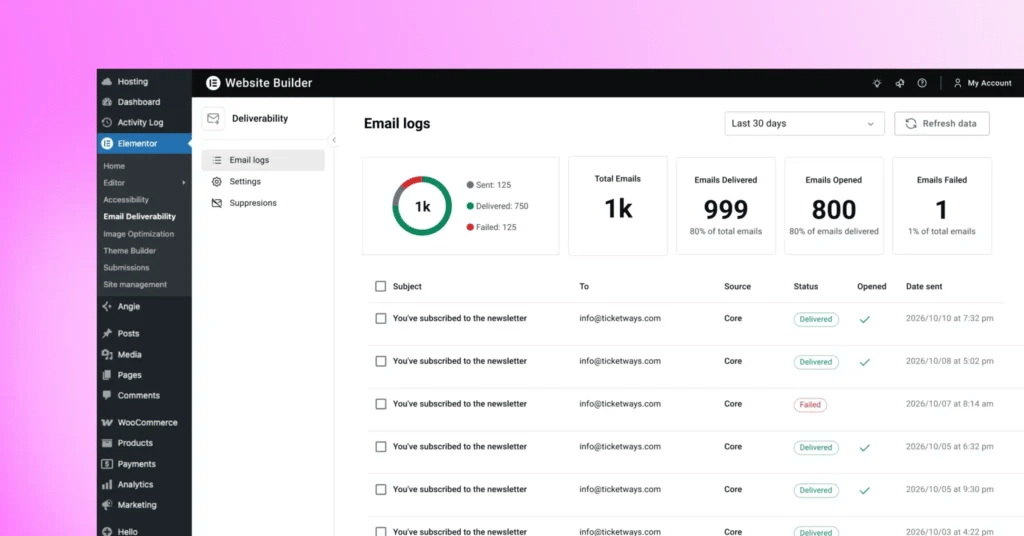
Both capabilities are included in One and work within the same environment the team already uses to build.
“Elementor One gives us a lot of those tools, built right into a system that is already in place on those sites,” Smith says.
That’s what makes the difference for agencies. The real cost of adding a new tool is never just the license fee. It is the migration effort, the learning curve, and the compatibility testing time.
When the capability is already built into the environment where the work happens, the barrier to using it disappears.
Reclaimed hours and protected margins
Maintenance tasks that used to consume unbillable hours now happen through tools already built into the workflow, without touching client rates.
“We have definitely saved time, which is also money saved,” Smith shares. “Elementor One has helped us find ways to save time that has already been built into clients’ maintenance plans for updating sites.”
That is the version of margin protection that works long term. Not passing rising costs on to clients, but eliminating the hidden overhead that was chipping away at margins in the first place.
Maintenance tasks that previously required separate setup and manual troubleshooting now happen through tools already integrated into the workflow.
“Elementor One is closing the gap on the need for some other plugins,” says Smith. Every tool consolidated means one fewer license, one fewer compatibility issue, and one fewer source of untracked overhead.
The agencies protecting their margins right now are not doing it by raising rates. They are doing it by eliminating the overhead that was quietly eroding them.
Elementor One is the professional standard that makes that possible: capabilities needed to create, optimize, and manage client sites unified in one place, with no separate licenses and no manual setup absorbed into every client retainer.
Every month you run a fragmented toolkit is another month your counterparts are operating at a lower overhead cost.
The professional standard has changed, and this is what it looks like. Explore Elementor One →
Already an existing Elementor Pro user? Upgrade to One and get credited for the remainder of your Pro plan.
FAQs
Who is 2oddballs Creative?
2oddballs Creative is a web agency that has been building client sites with Elementor for over seven years. The agency manages a multi-site portfolio, with a workflow built around Elementor One to handle both new builds and ongoing site maintenance.
How does 2oddballs Creative use Elementor One?
2oddballs Creative uses Elementor One to manage maintenance and performance updates across its client portfolio. The agency relies on One’s built-in Email Deliverability and Image Optimization tools to handle tasks that previously required separate tools, reducing the unbillable overhead absorbed into their retainers.
How did Elementor One help 2oddballs Creative?
Elementor One resolved two recurring cost drains: SMTP and webmail delivery problems, and a backlog of older client sites that needed WebP image optimization. Both are now handled through tools built into the environment the team was already working in, saving time across the portfolio without any rate increases to clients.
What is Elementor One?
Elementor One is a unified subscription for web agencies and creators that consolidates the Elementor Editor Pro, Email Deliverability, Image Optimization, Site Management, Web Accessibility, and other key capabilities under a single environment. It allows agencies to spend less time on maintenance and more time on billable work.

