Choosing an AI app builder in 2026? Lovable and v0 by Vercel are two of the most-discussed tools for generating web applications from natural language prompts. They serve very different audiences. This article compares both tools fairly across the dimensions that matter to professional web creators, then makes the case for Sticklight as the stronger choice for anyone building production-ready websites, apps, dashboards, and tools for clients or for themselves. Sticklight is the vibe-coding platform for professional web creators, built by the Elementor team and powered by Claude.
Key takeaways
- Lovable is an AI-powered app builder suited to non-technical founders and indie makers who want to go from prompt to working app fast, without writing code from scratch.
- v0 by Vercel is a generative UI tool for frontend engineers already working inside React and Next.js codebases who need AI assistance generating components.
- Lovable covers more of the creation cycle than v0, but both tools are built for getting to a working first version, not necessarily a production-ready shipped product.
- Professional web creators who build for clients need production output, not a prototype. Output that meets design standards, passes a security scan, and ships with SEO built in from the first prompt.
- Sticklight is the AI app builder that spans websites, apps, dashboards, CMS, booking systems, and internal tools from a single prompt-first flow, with a Skills system that embeds packaged expertise at build time and a full Publish phase included.
- Built by the Elementor team. Powered by Claude. Sticklight brings a decade of professional web creation pedigree to every prompt.
What is Lovable and who is it for?
Lovable is an AI-powered app builder that generates full-stack web applications from natural language prompts. A user describes what they want to build, and Lovable produces a working application, handling frontend structure and some backend logic in the process. The tool is designed to compress the time between “I have an idea” and “I have a working app” for people who are not starting from a codebase.
The primary audience is non-technical founders, indie makers, and developers prototyping new product ideas. Lovable suits people who want to validate a concept, build a marketing application, or spin up an MVP without going through a full development cycle. The platform has an active community, ships features regularly, and has earned a reputation as one of the more capable tools in the prompt-to-app category.
What Lovable does well.
Lovable’s core strength is speed from idea to a functional first version. For founders validating a product concept, or creators who want a working demo to share with stakeholders, the prompt-to-app generation covers significant ground quickly. Frontend structure, navigation, and basic interaction logic all come out of a single description.
The community around Lovable is active. Shared examples and templates help new users understand what the tool can produce, and the barrier to getting started is low. Regular feature releases keep the platform moving forward. That is a clear advantage for users who do not have a development background.
Who Lovable is best for.
Lovable fits non-technical founders validating ideas, indie makers building consumer apps, and developers who want a fast first draft they can extend. It is a strong starting point for anyone whose goal is a working proof of concept, not a finished client delivery.
Lovable pricing.
Lovable offers a free tier to start exploring the platform, with paid plans that increase the number of prompts, messages, and project capacity available. Pricing scales with usage. Check the Lovable website for current plan details, as these change with platform updates.
What is v0 by Vercel and who uses it?
v0 by Vercel is a generative UI tool, not a full AI app builder. It produces React and Tailwind CSS components from text or image prompts, designed to fit into an existing Next.js project or Vercel-based codebase. The output is clean, structured React code that a developer can copy into their project or deploy through Vercel’s infrastructure.
The tool sits inside an engineering workflow. A developer describes a component they need, v0 generates it, and they integrate it into their codebase. The tight coupling with Vercel’s deployment and edge infrastructure means v0 is most useful for teams already operating inside that ecosystem.
What v0 does well.
v0 produces high-quality React component output. For engineers who know exactly what UI component they need and want AI to accelerate the writing of it, v0 delivers clean, usable code. The integration with Vercel’s deployment pipeline means generated components can move into production quickly for teams already using that stack.
The tool also handles image-to-component generation. Engineers can upload a design or sketch and get structured React code back. For frontend teams working at speed inside an established Next.js project, this is a genuine time saver.
Who v0 is best for.
v0 is for frontend engineers and full-stack developers working inside React and Next.js codebases who want AI assistance generating components. It is not a builder for non-technical users, and it is not a path from idea to published product. It is a code-generation accelerator inside an existing engineering workflow.
v0 pricing.
v0 offers a free tier with a limited number of generations per day, and premium plans that increase generation credits and unlock additional capabilities. Pricing is usage-based. Check the v0 website for current plan details.
Lovable vs v0: side-by-side comparison of AI app builders.
The table below compares Lovable, v0 by Vercel, and Sticklight across the dimensions that matter to professional web creators. The goal is a clear, honest picture of where each tool fits.
| Dimension | Lovable | v0 by Vercel | Sticklight |
|---|---|---|---|
| Primary audience | Non-technical founders, indie makers, developers prototyping | Frontend engineers, full-stack developers inside React/Next.js | Professional web creators: agencies, freelancers, studios, independent builders |
| What it builds | Full-stack web apps, MVPs, marketing applications | React and Tailwind UI components and page sections | Websites, landing pages, web apps, dashboards, CMS, booking systems, internal tools, forms, databases, full digital experiences |
| Creation flow | Prompt-to-app generation | Prompt-to-component generation inside an existing codebase | Prompt, Build (with Skills), Publish: full cycle from idea to live URL |
| Output quality bar | Working first version, suited to prototyping and MVPs | Clean React code for integration into an existing project | The Sticklight standard: craft of a senior designer and developer on every build |
| Skills / packaged expertise | Not a core feature | Not applicable (component output only) | Nine live Skills: SEO, Accessibility, Performance, Design System, Copywriting, Localization, Micro-interactions, Onboarding, 3D Web Experience |
| Publish built in | Partial (depends on plan and integration) | Via Vercel deployment, requires engineering setup | SEO, security scan, custom domain, and hosting included in every project |
| Manual canvas control | Limited post-generation editing | Code-level editing in the developer’s IDE | Full manual editing of every pixel after the AI builds, no lock-in |
| Technical requirement | Low (suitable for non-technical users) | High (requires React/Next.js knowledge and an existing codebase) | None required. Professionals of all technical levels use it; code editing available for those who want it |
| Pedigree | Independent AI-first product | Vercel (infrastructure and developer tools) | Built by the Elementor team. Powered by Claude. |
| Free plan | Yes | Yes (limited generations) | Yes |
How Lovable and v0 differ as AI app builders.
Lovable and v0 by Vercel are not the same kind of tool, and they do not compete for the same user. The clearest way to understand the gap is to ask what each tool is actually replacing in a creator’s workflow.
Lovable replaces the development cycle for early-stage product ideas. It is an AI app builder for people who do not have a codebase yet and want to get to something functional without starting from scratch. The tool handles more of the creation surface and is genuinely accessible to users without a technical background.
v0 replaces the time a developer spends writing boilerplate UI code. It assumes the developer already has a codebase, already knows React, and already has a deployment pipeline. It accelerates one specific part of an engineering workflow, not the full creation cycle.
A founder without technical skills would have no clear path with v0. There is nowhere to put the component without an existing project. A frontend engineer running a Next.js app would find Lovable’s full-app approach too coarse. They want a specific component, not a new project.
Both tools share one limitation. Neither is primarily built for the professional web creator who ships production products to clients, where design standard, SEO, security, and full creative control are non-negotiables. For that creator, both tools leave something on the table.
Why professional web creators need more than a fast first version.
Prototyping and shipping are different jobs. A working demo that validates an idea has real value. A production product delivered to a client, hosted on their domain, discoverable by search engines, and built to a design standard that protects a professional’s reputation is something else entirely.
Professional web creators, whether agencies, freelancers, or studios, work in the second category. Speed matters. So does the final quality of what ships. An app that looks generated and never polished is a problem for a freelancer billing for professional work. A landing page not optimized for search is a problem for an agency running a campaign. A client dashboard that does not pass a basic security review is a problem for a studio that needs to maintain client trust.
Lovable is a strong option for founders getting to a first version. v0 is a useful tool for engineers writing component code faster. Neither was designed primarily around the delivery standard a professional web creator needs to protect their reputation on every build.
That is the gap Sticklight fills. The way it fills it is specific.
Why Sticklight is the stronger AI app builder for professional creators.
Sticklight is the vibe-coding platform for professional web creators, built by the Elementor team and powered by Claude. It is built for the same people who build websites for a living: agencies, freelancers, studios, and independent creators launching their own products. And it takes them further than a website.
Websites, landing pages, web apps, dashboards, CMS, booking systems, internal tools, forms, databases, and full digital experiences all come from the same prompt-first flow. Go beyond websites. Become a full-stack creator.
The platform moves through three phases: Prompt, Build, and Publish. Each phase is designed to remove the friction that slows professional delivery.
Prompt: from idea to plan without guesswork.
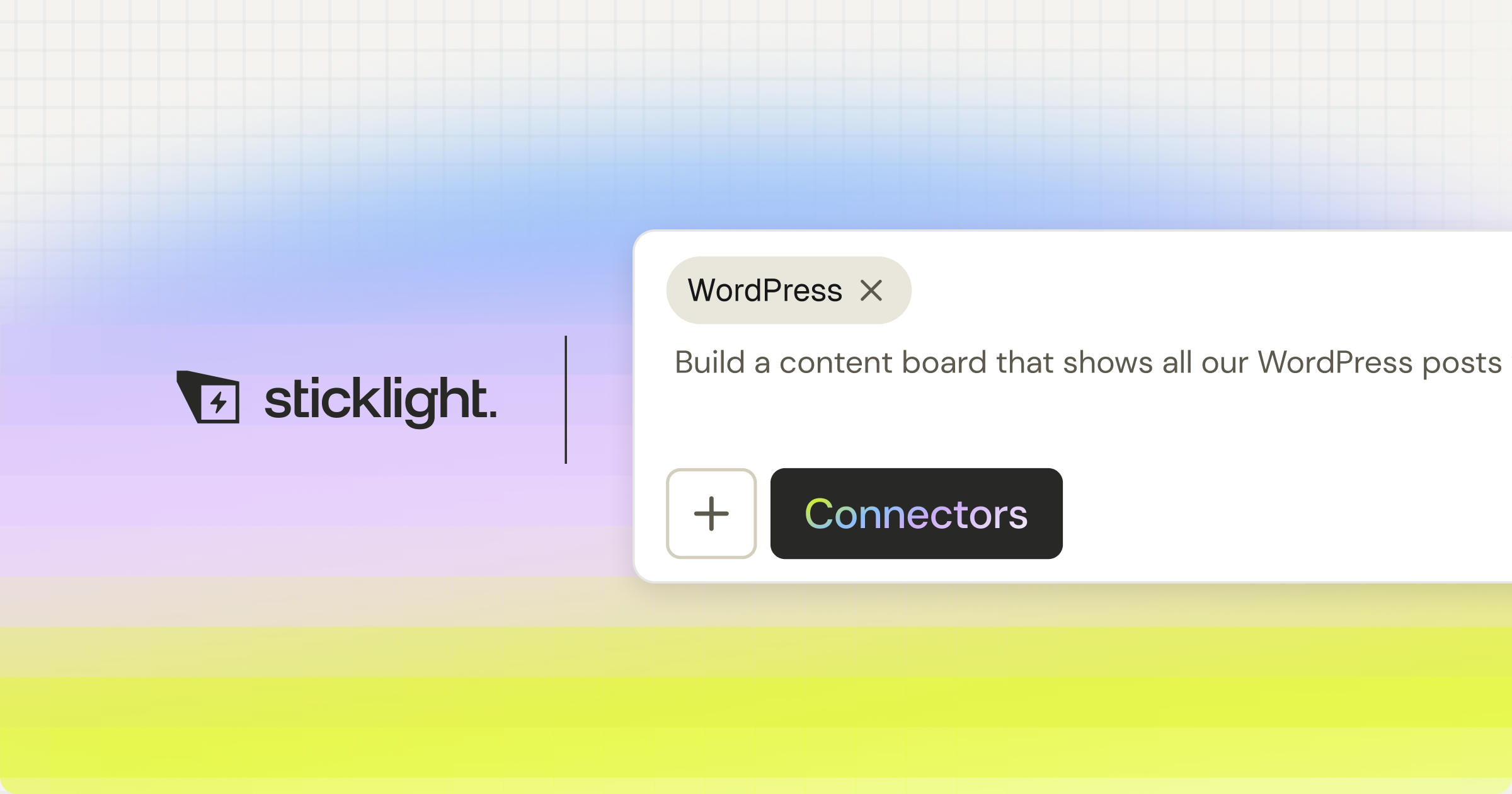
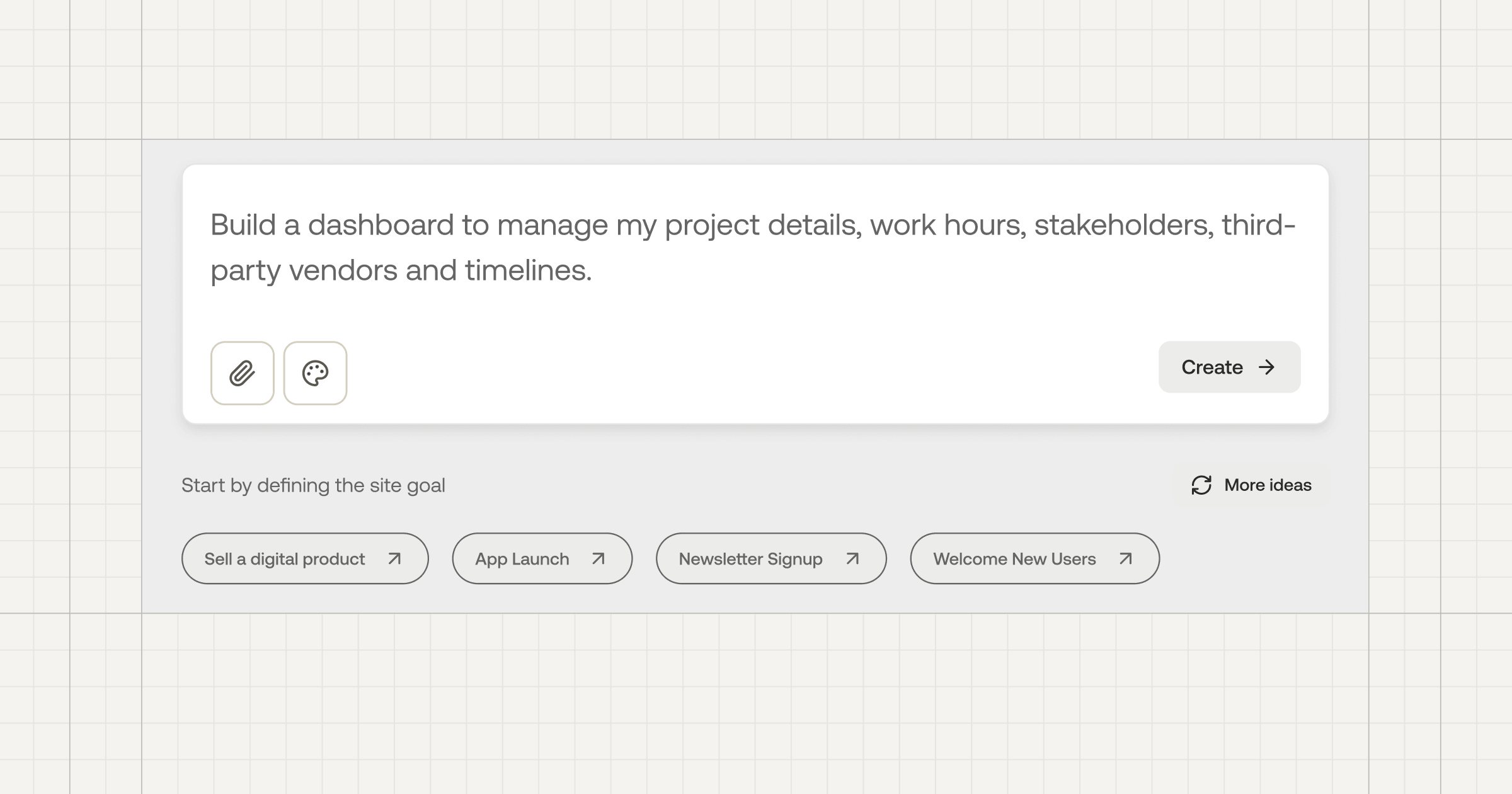
Every Sticklight project starts with natural language. The main prompt box takes a description and begins the build. For more complex projects, Plan Mode breaks the task into steps before any code runs, so the creator reviews the plan before committing. Sticklight MCP connects Sticklight to the creator’s existing tools. Templates and Connectors give a head start without locking the creator into someone else’s structure. Agents are on the roadmap and will expand the automation capabilities further (coming soon).
Build: the Skills system as packaged expertise.
Skills are what separate Sticklight from other AI app builders in a concrete, measurable way. A Skill is a packaged unit of expert know-how added to any build with one click. Nine Skills are live: Accessibility, SEO, Design System, Performance, Copywriting, Localization, Micro-interactions, Onboarding, and 3D Web Experience (Three.js).
The SEO Skill ships meta tags, schema markup, sitemap configuration, and on-page best practices as part of the build, not as a manual step afterward. The Accessibility Skill ships WCAG-compliant markup, focus states, and ARIA attributes. The Performance Skill optimizes for load speed. These are not settings to configure. They are capabilities that run at build time, compounding across every project. The tenth build is faster and sharper than the first.
After the AI builds, the creator has full manual control of every pixel on the canvas. Code editing is available directly for those who want it. The AI does the heavy lifting. The creator controls the outcome. That is the distinction between a production tool and a demo generator.
Publish: production-ready, not a prototype you have to rebuild.
The Publish phase is where professional delivery happens. SEO is built into every Sticklight project from the start. A security scan runs on every build. Custom domain connection is included. App hosting is included.
A creator goes from prompt to a live URL without a separate deployment workflow, without configuring infrastructure, and without an engineering dependency between their idea and the client’s browser. This is what separates Sticklight from both Lovable and v0. Lovable gets to a working app without the complete Publish phase built in at the same level. v0 generates components that require an engineering team to ship at all. Sticklight ships a finished, production-grade product as the default output.
The pedigree behind the platform.
Sticklight is built by the Elementor team, the organization that has spent a decade building tools for professional web creators. Elementor’s mission is empowering web creators to build their future. Sticklight extends that mission into the AI era, powered by Claude, Anthropic’s frontier model. Built by the Elementor team. Powered by Claude. That combination is the basis of the Sticklight standard: the craft of a senior designer and developer on every prompt.
Elementor and WordPress are part of the same ecosystem. Sticklight is always additive to both. WordPress remains a source of truth to build on and connect to. Different tools for different jobs, for an audience smart enough to use the right tool at the right moment. For web creators already using Elementor to build WordPress sites, Sticklight expands the surface area of what they can deliver, not the tools they have to leave behind.
What professional creators can build with Sticklight.
The full surface range is where the case becomes clear. Sticklight builds websites and landing pages, as other AI builders do. It also builds web apps, dashboards, CMS, booking systems, internal tools, forms, database-backed products, management platforms, embedded tools, and full digital experiences. All from the same prompt-first flow. All with the Skills system active at build time. All with the Publish phase included.
A freelancer who builds websites for clients can use Sticklight to ship a client’s booking system in the same workflow. An agency that runs landing pages at volume can apply the SEO and Performance Skills on every build without adding a separate optimization step. A studio building internal tools for a client can deliver a management dashboard that meets the client’s design standard, passes a security scan, and is live on the client’s domain before the next stand-up.
This is what “beyond websites” means in practice. The same professional. The same platform. A much wider range of what they can deliver and charge for.
“The question for professional web creators is not whether AI builders are fast. Most of them are fast at getting to a first version. The question is what happens between that first version and the moment a client accepts the delivery. Skills, security, SEO, full canvas control after the build: those are the gaps that separate a production tool from a demo generator. That is the gap Sticklight is built to close.”
Itamar Haim, AI for WordPress Specialist
Sticklight pricing overview.
Sticklight offers a free plan to try the platform and ship real products. Pro scales for independent creators, freelancers, and small studios. Team adds multi-seat collaboration, more Skills capacity, and higher project volume. Enterprise includes SSO, security review, and dedicated support. A bring-your-own-keys option is available on select plans for LLM cost control. Pricing scales with seats and feature access, not page count or usage volume. Check the Elementor blog for updates on Sticklight plans and features as the platform evolves.
How to choose the right AI app builder in 2026.
The right AI app builder depends on what you are building and who you are building it for. Here is how each tool maps to a real use case.
If you are a non-technical founder who needs to validate a product idea quickly and get to a working proof of concept, Lovable is a strong starting point. It lowers the barrier to app creation and moves fast from prompt to functional first version.
If you are a frontend engineer working inside an existing React and Next.js codebase who wants AI to generate UI components faster, v0 by Vercel is a focused, capable tool for that specific job inside that specific stack.
If you are a professional web creator, an agency, freelancer, studio, or independent builder delivering work to clients or launching your own products, a fast first version is not enough. You need the full creation cycle. Output that meets a design standard, ships with SEO and security built in, gives you full creative control after the AI builds, and covers not just websites but the full range of what clients ask you to build.
That is Sticklight. Built for the professional. Built for production. Built to go beyond websites.
Web creators who want to understand how AI fits into a professional publishing workflow will find useful context on the Elementor blog, where the team covers tools, techniques, and how the web creation profession is changing in the AI era.
Frequently asked questions
What is the difference between Lovable and v0 by Vercel as AI app builders?
Lovable is a full AI app builder that generates complete web applications from natural language prompts, designed for non-technical founders and makers. v0 by Vercel is a component generator that produces React and Tailwind CSS code, designed for frontend engineers already working inside a Next.js project. Lovable covers more of the creation surface; v0 accelerates one specific part of a developer’s existing workflow. The two tools serve different audiences with different goals.
Is Lovable good for professional web creators building client work?
Lovable is strong for rapid prototyping and getting to a working first version, but it is not optimized for professional client delivery. Professional web creators who need to deliver production-ready work to clients, with design standards, SEO, security scans, and full post-AI control over the output, will find that Lovable’s primary strength is speed to a working prototype rather than production delivery. That gap is where Sticklight, the vibe-coding platform built for professional creators who ship for clients, is designed to operate.
Does v0 by Vercel work without a coding background?
No. v0 by Vercel requires an existing Next.js or React project, knowledge of how to integrate generated components into a codebase, and a Vercel-based deployment workflow. It is purpose-built for frontend engineers, not for non-technical users or creators who want to go from idea to published product without writing code.
What is the Sticklight Skills system and how does it differ from other AI builders?
Skills are packaged units of expert know-how added to any Sticklight build with one click. Nine Skills are live: SEO, Accessibility, Performance, Design System, Copywriting, Localization, Micro-interactions, Onboarding, and 3D Web Experience (Three.js). Instead of configuring these capabilities manually after the AI generates something, Skills run at build time and embed their expertise directly into the output. The SEO Skill ships meta, schema, sitemap, and on-page best practices as part of the build. The Accessibility Skill ships WCAG-compliant markup and ARIA. Skills in this form are not available in Lovable or v0.
What can I build with Sticklight that I cannot build with Lovable or v0?
All three tools can produce websites and web applications. The difference is in scope and delivery. Sticklight builds websites, landing pages, web apps, dashboards, CMS, booking systems, internal tools, forms, database-backed products, management platforms, and full digital experiences, all from the same prompt-first flow, all with the Publish phase (SEO, security, hosting, custom domain) included by default. Neither Lovable nor v0 covers the full creation cycle from prompt to live, published URL with built-in SEO, security scanning, and hosting at the same level Sticklight does.
How does Sticklight relate to Elementor and WordPress?
Sticklight is built by the Elementor team and shares the same mission: empowering web creators to build their future. The two products are complementary, not competing. Elementor is a professional-grade visual builder for WordPress. Sticklight is an AI-native creation platform that goes beyond websites into apps, dashboards, and tools. WordPress is a source of truth you can build on and connect to. Web creators who use Elementor and WordPress for client work can use Sticklight to expand the range of what they deliver without leaving behind the tools and workflows they already trust. You can learn more about the Elementor ecosystem at elementor.com.
Is Sticklight suitable for agencies managing multiple client projects?
Yes. Sticklight’s Team plan adds multi-seat collaboration, more Skills capacity, and higher project volume. The Skills system compounds across projects: every new build benefits from the expertise packaged in Skills applied on previous ones. Agencies that run landing pages, client sites, and tools at volume find the combination of AI generation, packaged Skills, and the full Publish phase in a single platform reduces the number of tools in their stack without reducing the standard of what they ship.
What does “production-ready” mean in the context of Sticklight?
Sticklight defines production-ready as meeting the Sticklight standard: the combined craft of a senior designer and developer. In practice this means the output has the design quality, code structure, SEO configuration, security posture, and performance characteristics that a professional would expect from finished work, not from a prototype. The security scan that runs on every build, the SEO built into every project, and the full creative control the creator keeps after the AI finishes are what give “production-ready” a specific meaning on the Sticklight platform, rather than being a marketing claim.
Can I edit Sticklight output after the AI builds it?
Yes. Full manual editing of every pixel is available on the canvas after the AI generates the initial build. Direct code editing is also available for creators who want it. Sticklight is designed so the AI does the heavy lifting from the first prompt, and the creator takes full control of the outcome. The AI does not lock you out of your own product. Prompt to start, full control to finish.
Let it glow.

