Table of Contents
Look, Framer completely changed how we approach visual web design. It brought the freeform canvas feel straight into the browser. But visual perfection doesn’t solve every technical problem your clients bring to the table.
Eventually, designers hit a wall when project requirements scale past basic layouts. You’re suddenly fighting against strict hosting limits and rigid data structures. That’s exactly why we’re breaking down the top alternatives available right now.
Key Takeaways
- WordPress maintains a massive lead, powering 43.5% of all websites globally.
- Elementor controls 9.5% of the web, dominating the self-hosted design market.
- Framer’s $15/month per-site pricing scales poorly for agencies managing dozens of clients.
- Webflow charges approximately 53% more for its CMS plan but delivers superior database tools.
- The global no-code development market will reach $187 billion by 2030.
- A tiny 0.1-second delay in mobile load times can slash retail conversions by 8.4%.
Why Designers Are Moving Beyond Framer in 2026
Framer feels like powerful when you first drag a frame onto the screen. You don’t have to think about code. You just design. You pull elements around, adjust the padding, and suddenly you’ve got a functioning website.
But that powerful has strict boundaries. The ecosystem is entirely closed off. 100% of sites built on the platform must use their proprietary hosting infrastructure. You can’t export your site to a cheaper host. You can’t hand the code over to a client’s internal IT team. This creates a massive bottleneck for fast-growing companies.
The modern web runs on flexibility. Businesses want agile, adaptable systems. They don’t want to be locked into a single vendor’s server ecosystem forever.
Here’s why professionals actively seek other options:
- Hosting Lock-in – You don’t own the underlying infrastructure.
- Scaling Costs – The basic $15/month plan destroys profit margins when you manage 47 client sites.
- CMS Limitations – Complex relational databases simply aren’t possible natively.
- E-commerce Friction – Roughly 20% of users migrate specifically because they need better store functionality than basic embeds provide.
- Performance Ceilings – You can’t implement custom server-side caching rules.
- Data Portability – Moving thousands of blog posts out of the system is unnecessarily complex.
The modern web demands more than just a pretty frontend. When you lock your data inside a proprietary system, you sacrifice long-term SEO growth and technical flexibility. True ownership means controlling both the design and the infrastructure.
Itamar Haim, SEO Team Lead at Elementor. A digital strategist merging SEO, AEO/GEO, and web development.
Data ownership matters more than ever. You need tools that give you absolute control over the final output. Retail sites see a massive 8.4% drop in conversions for just a 0.1-second delay in mobile load times. You simply can’t afford to surrender your server optimization to a closed third-party platform.
1. Elementor: The Ultimate Professional Alternative
Elementor takes the visual freedom of a canvas and grounds it in the reality of open-source software. You get the design capabilities without the restrictive proprietary jail.
This platform powers exactly 9.5% of all websites worldwide. You aren’t just adopting a tool. You’re entering a massive, open ecosystem backed by thousands of developers. When you build on WordPress, you tap into an architecture that powers 43.5% of the global web.
The Elementor Editor Pro gives you a drag-and-drop live editor with responsive controls for every breakpoint. You control the styling down to the pixel. You dictate the global brand settings. And you host it wherever you want. Sites built with Elementor and the barebones Hello Theme regularly achieve Core Web Vitals pass ratings in the 90th percentile. You aren’t sacrificing speed for visual appeal.
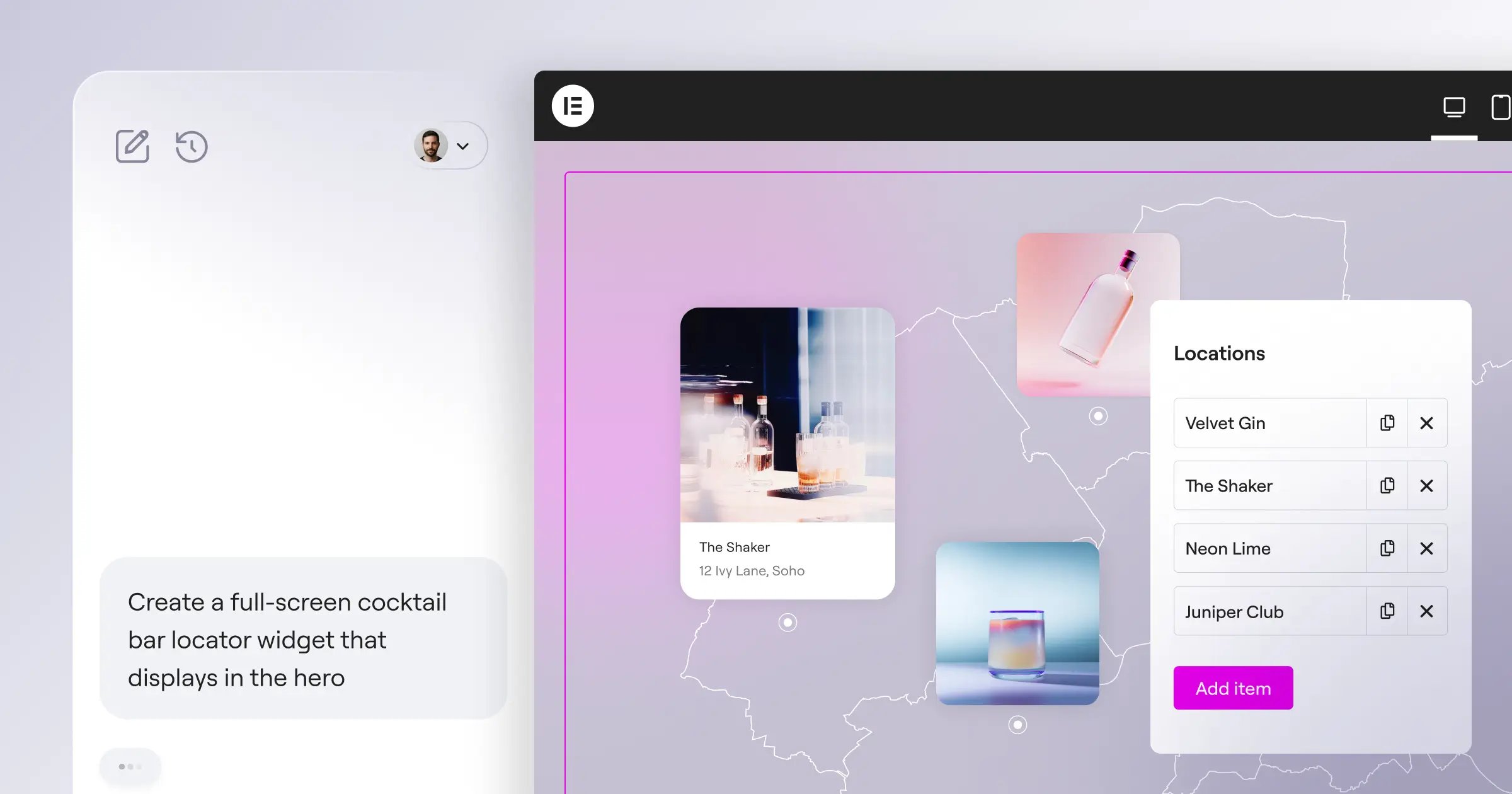
That’s where Angie completely flips the script for WordPress developers. Angie is an agentic AI that takes action inside your site using the Model Context Protocol. You just type what you need. It builds production-ready WordPress assets straight from your conversation. It doesn’t just spit out text. It executes design tasks within the Elementor ecosystem perfectly.
Consider the pros and cons of this approach:
- Pro – Full portability. Move your site to any host at any time.
- Pro – Massive cost savings. The Essential plan is just $60/year for one site.
- Pro – Native WooCommerce integration for serious e-commerce builds.
- Pro – Complete ownership of your underlying database architecture.
- Con – Requires managing your own WordPress hosting stack.
- Con – The initial setup for WordPress core settings takes time.
Honestly, this is where Elementor really shines compared to strict SaaS tools. You’ll save thousands of dollars annually on hosting alone when managing multiple clients.
2. Webflow: The Industry Standard for High-End Interaction
If you demand granular control over every CSS property, Webflow is your logical next step. It bridges the gap between front-end development and visual design.
Targeting professional web designers and mid-market tech companies, it delivers complex animations that simple drag-and-drop tools struggle to match. The Interactions 2.0 engine gives you visual controls for JavaScript animations. You can trigger complex sequences based on scroll position, mouse movement, or page load states. You aren’t just placing elements. You’re choreographing them.
But this power comes at a steep price. The CMS plan costs $23/month when billed annually. That’s a massive 53% jump over Framer’s entry tier. If you manage 53 client sites, that recurring cost eats directly into your agency’s profit margins.
Follow these exact steps to transition from a visual canvas to Webflow:
- Export your structural assets, icons, and image files manually from your current tool.
- Rebuild your global color and typography classes in the Designer interface.
- Configure your CMS Collections before designing the template pages.
- Map your dynamic data fields to the layout elements.
- Recreate your scroll effects using the Interactions panel.
- Publish to a staging domain to test your logic structures.
Webflow excels at database logic but demands a firm understanding of the CSS box model. You can’t just drop items arbitrarily. You must understand flexbox, grid layouts, and absolute positioning.
3. Wix Studio: The Agency Powerhouse
Agencies need to move fast. They need client handoff to be entirely painless. Wix Studio was built specifically for this high-volume agency model.
They didn’t just rebrand their old consumer-level builder. They engineered a completely new professional workspace. The industry responded immediately. Within its first year, Wix Studio saw over 1 million sites launched on its platform. They aggressively targeted designers who felt alienated by overly complex development workflows.
The standout feature is Responsive AI. You design the desktop view, click a button, and the system intelligently scales the layout for tablet and mobile screens. It saves hours of tedious breakpoint adjustments. You review the AI’s suggestions, tweak the padding, and move to the next section.
Agency-specific features include:
- A centralized dashboard for managing hundreds of client accounts from one screen.
- Custom roles and permissions for designers, copywriters, and external clients.
- Reusable CSS grid templates that deploy across multiple independent projects.
- Native client billing and subscription management tools built directly in.
- Integrated marketing modules for email campaigns and social posting.
- Built-in analytics dashboards that require zero third-party code installation.
You’re getting an all-in-one business management tool wrapped around a high-end visual builder. You don’t have to string together five different subscriptions to run an agency.
4. Bubble: For Web Apps Beyond Static Design
Sometimes a website isn’t enough. When a client asks for user portals, complex databases, or SaaS-like functionality, static builders fail completely. Bubble fixes this specific problem.
Bubble is for building actual web applications. Its user base surpassed 3.3 million people recently, proving the massive demand for logic-heavy visual builders. People don’t just want brochures anymore. They want functional software.
Most canvas tools make things look pretty. Bubble makes things work. You get a visual Workflow API that handles user authentication, database triggers, and complex third-party API connections. You define what happens when a user clicks a button, step by step.
Unlike the prompt-driven approach of Angie in WordPress, Bubble requires manual logic mapping. You physically draw the database relationships. It’s programming without the syntax errors.
Consider Bubble when:
- Your project requires users to create unique accounts and log in securely.
- You need to store, filter, and manipulate vast amounts of user-generated data.
- You’re building a two-sided marketplace connecting buyers and sellers.
- You want to process payments based on complex, variable usage metrics.
- Your client needs a custom internal dashboard to track business operations.
- You must integrate deeply with legacy enterprise APIs.
It won’t win any visual design awards out of the box. Honestly, the default UI looks slightly dated. But it will run your entire custom business logic flawlessly without touching a single line of backend code.
5. Dorik: The Budget-Friendly Landing Page King
Not every project needs a heavy monthly subscription. Sometimes you just need to validate a startup idea quickly before writing a massive check. Dorik dominates this specific, budget-conscious niche.
Dorik is unapologetically simple. It offers a massive library of 80+ UI components. You drop them in, change the text, swap the background image, and hit publish. There’s no complex grid logic to learn.
The pricing is incredibly aggressive. Their Personal plan starts at a tiny competitive ratesnth. That completely undercuts the competition. When you compare that to a $15 or $23 monthly fee, the yearly savings become substantial for solo creators.
Here’s a quick checklist to see if Dorik fits your exact needs:
- Are you building a single-page landing site for a specific ad campaign?
- Is your primary goal collecting email addresses for an upcoming launch?
- Do you need to launch the entire project within the next 48 hours?
- Is your software budget strictly limited to under $10 a month?
- Do you require built-in, basic membership gating without external plugins?
- Are you willing to sacrifice deep custom animations for raw speed?
- Do you want native integrations with tools like Mailchimp and Zapier?
If you answered yes to most of these, stop overpaying for premium design tools. Grab a cheap plan and get your idea into the market immediately.
6. Siter.io: The Direct Figma-to-Web Competitor
Many designers just want their Figma files to turn into websites instantly. No coding. No complex CMS configurations. Just pure visual translation. Siter.io delivers exactly this zero-code transition.
Other platforms offer import plugins that constantly break. But Siter built its entire architecture around this single Figma-to-web workflow. You use freehand positioning. Elements stay exactly where you placed them on the canvas. If you put a button three pixels from the edge, it stays three pixels from the edge.
Their Professional plan sits at an attractive $12/month. This saves you roughly 20% compared to the market average for dedicated visual builders.
Follow these tips for the best Siter experience:
- Group your Figma layers logically before starting the import process.
- Use standard web-safe fonts in your initial design files to prevent rendering errors.
- Keep your mobile breakpoint designs in a separate, clearly labeled frame.
- Test your interactive states locally before pushing the live synchronization.
- Flatten complex vector illustrations into single SVG files to improve load times.
- Remove hidden layers from your design file to prevent code bloat.
You won’t find deep backend logic here. You won’t find a massive plugin ecosystem. You’ll find the absolute fastest way to get a design off your hard drive and onto a custom domain. It respects your time above everything else.
7. Plasmic: The Headless Visual Builder
Product teams using modern JavaScript frameworks face a unique technical challenge. They desperately want visual editing for their marketing teams, but they can’t abandon their highly optimized, custom codebase. Plasmic bridges this technical gap perfectly.
It operates as a headless visual builder. You design components visually, then publish them directly into your existing React or Next.js application. The design tool acts as the CMS for your frontend layout.
This flexibility is crucial for the massive $187 billion low-code market. Developers maintain absolute control of the source code. Marketing teams get to update the UI daily without filing a single Jira ticket or begging engineering for help.
Here’s how a typical Plasmic integration works:
- Developers install the Plasmic SDK into the existing application repository.
- Designers build the UI components in the Plasmic web interface using visual tools.
- The platform generates clean, production-ready React code in the background.
- The marketing team runs visual A/B tests and localizes content directly.
- Changes deploy instantly via the API without requiring a full application rebuild.
- Engineers swap out basic visual elements for complex, state-driven custom components.
You get the benefits of a visual canvas while maintaining the strict performance standards of a custom-coded web application. It’s the ultimate compromise between marketing agility and engineering rigor.
8. Readymag: For Creative Storytelling and Editorials
Digital magazines, fashion brands, and high-concept portfolios require a completely different feature set. Standard grid systems restrict pure creativity. Readymag throws the traditional web grid completely out the window.
Editorial designers flock to this platform in droves. It allows for advanced typographic control that heavily mimics print design software. You can create custom cursors, complex scroll-jacking animations, and floating interactive elements that break all standard usability rules in the name of art.
It isn’t built for standard corporate websites. It’s built for immersive visual experiences that demand user attention.
Key creative features include:
- Absolute positioning without underlying structural CSS constraints.
- Native integration for high-resolution, uncompressed video backgrounds.
- Draggable layout elements that users can physically interact with on the live site.
- Custom variable font support with visual weight and width slider controls.
- Granular animation timelines that look like video editing software.
- Built-in analytics that track exact user scroll depth on long-form articles.
When your primary goal is winning industry design awards rather than generating basic B2B sales leads, this platform provides the blank canvas you actually want. You aren’t building a site. You’re directing a digital editorial.
9. Ycode: The Visual Builder for Airtable Lovers
Data-driven design usually requires complex API knowledge and hours of backend configuration. Ycode changes that harsh reality by deeply integrating with external databases from day one.
It serves no-code builders who practically live inside spreadsheets. Instead of forcing you to use an underpowered internal CMS, Ycode treats Airtable as a first-class citizen. You sync your external bases directly to the visual builder interface.
This creates an unbelievably powerful workflow for building directories, real estate listings, and job boards.
Consider a standard data scenario using Ycode:
- You manage a constantly updating list of 517 remote jobs in an external Airtable base.
- You map those specific records to a responsive, repeating grid layout in Ycode.
- When your team updates a single row in Airtable, the live website updates instantly.
- You add native user authentication so visitors can register and save their favorite listings.
- You implement complex filtering systems based on Airtable’s categorical tags.
- You deploy the entire setup without writing a single database query.
You avoid the strict database limitations of simpler canvas platforms while completely dodging the steep learning curve of enterprise application builders. It hits the perfect middle ground for data-heavy projects.
10. Divi: The Visual Theme Alternative
Not everyone wants to sign up for another SaaS subscription. The massive WordPress ecosystem offers multiple visual builders, and Divi remains a dominant player for a very specific type of independent user.
DIY business owners and WordPress loyalists deeply appreciate Divi’s lifetime pricing model. You pay a single flat fee once. You use it on absolutely unlimited client sites forever. That completely destroys the recurring cost model of modern cloud builders that bleed your wallet every single month.
The Divi Cloud feature allows you to save custom layouts and deploy them across entirely different server environments in seconds.
Here’s why some users strongly prefer this traditional route:
- Absolute, unrestricted ownership of the final website files and database.
- Zero monthly subscription fees eating into your hard-earned agency profits.
- Direct access to thousands of third-party plugins in the global WordPress repository.
- A massive library of over two thousand pre-built layout packs included in the base price.
- A fiercely loyal community that shares custom CSS snippets and tutorial videos daily.
- Split testing tools built directly into the core theme builder architecture.
The interface feels older than modern canvas tools. But the financial math for high-volume freelancers is impossible to ignore. You buy it once, and your tool costs drop to zero.
The 2026 Framer Alternative Decision Matrix
Choosing the right tool depends entirely on your specific business model and technical requirements. You’ve to carefully weigh monthly costs against required functionality and long-term data ownership.
We’ve compiled the core data points into a direct comparison table. This covers the top contenders discussed above, stripping away the marketing speak to show you exactly what matters.
| Platform | Primary Strength | Starting Price | Best Used For |
|---|---|---|---|
| Elementor Editor Pro | Ecosystem control & Portability | $60/year | Agencies wanting full hosting freedom and WP power. |
| Webflow | Advanced CSS & Interactions | $23/month | High-end corporate websites with complex scroll animations. |
| Wix Studio | AI Scaling & Client Management | Varies by tier | Volume-based web design agencies needing rapid deployment. |
| Dorik | Extreme Cost Efficiency | competitive ratesnth | Rapid startup landing pages and cheap validations. |
| Bubble | Complex Application Logic | Workload-based | SaaS products, marketplaces, and internal tools. |
| Siter.io | Figma Import Fidelity | $12/month | Designers needing exact pixel translations instantly. |
Don’t just pick the tool with the prettiest interface. Pick the infrastructure that actively supports your client’s five-year growth plan and protects your agency’s profit margins.
Frequently Asked Questions
Is it hard to migrate a site from Framer to WordPress?
You can’t click a single button to migrate. You must export your image assets and manually rebuild the structural layouts. However, tools like Elementor make recreating visual designs incredibly fast once the initial setup finishes.
Do these alternatives impact my SEO rankings?
Yes. Closed platforms limit server-side optimizations. Self-hosted options give you total control over caching and technical SEO structure. You’ll generally see better long-term organic growth when you control your own server environment.
Can I use Figma with Elementor like I do with Framer?
You can’t do a direct native paste. But you can export your design tokens easily. Plus, modern AI assistants bridge this gap rapidly, turning visual concepts into functional WordPress widgets in minutes.
What happens if I stop paying for my subscription?
With cloud platforms, your site goes offline instantly. With self-hosted WordPress tools, your live site stays up forever. You simply lose access to premium updates and direct support until you renew your license.
Are visual builders bad for site loading speed?
Not anymore. Modern builders output remarkably clean CSS. If you optimize your images and apply strong caching protocols, you’ll easily pass Core Web Vitals assessments across both mobile and desktop views.
How does Webflow’s CMS compare to others?
It’s incredibly rigid but powerful. You strictly define your data fields upfront. It handles relational data much better than basic visual canvas tools, though it still falls short of custom external database solutions.
Do I need to know how to code to use these tools?
Absolutely not. Every tool listed here relies entirely on visual interfaces. But understanding basic CSS concepts like padding, margins, and flexbox will make your workflow significantly faster.
What’s the best Framer alternative for e-commerce?
Elementor paired with WooCommerce is the clear winner here. You get the visual design freedom of a canvas builder alongside the absolute most widely used e-commerce engine on the internet.
Can I self-host a Webflow site?
Technically yes, but practically no. You can export the static HTML, CSS, and JS. But the moment you export, you lose all CMS functionality and native form processing completely.
Looking for fresh content?
By entering your email, you agree to receive Elementor emails, including marketing emails,
and agree to our Terms & Conditions and Privacy Policy.

