Table of Contents
Your hero image can make or break a first impression. 63 percent of users click away from generic stock photography, and a photoshoot can blow your budget.
That’s why the right AI image generator for websites is a production tool. You can generate production-ready hero banners, scalable vector icons, and blog thumbnails in seconds.
Key Takeaways
- Native integration wins – tools built into your CMS save 4.5 hours a week by cutting tab switching.
- Format matters – 78 percent of AI tools output heavy PNGs, so convert to WebP for Core Web Vitals.
- Vector generation is finally viable – newer platforms output clean, precise SVGs for logos and UI elements.
- Prompt adherence has improved – the latest 2024 models render hex codes and brand colors accurately 89 percent of the time.
- Enterprise copyright safety – high-end platforms offer indemnification against IP infringement.
- Text-in-image works – modern generators render legible typography onto the image, no photo editor needed.
The Reality of Midjourney v6.5 for Hero Banners
Most designers call Midjourney v6.5 the king of photorealism, ideal for dramatic hero images, atmospheric textures, and lifelike photography. It runs through a third-party chat interface, but the output is worth it, with control over camera settings, lighting, and aspect ratios like a clean 16 by 9 hero banner.
Here’s a typical workflow:
- Type the imagine command with specific photographic terms.
- Add the aspect ratio parameter for a clean web header.
- Apply the stylize parameter to match the client’s aesthetic.
- Upscale with a tool like Magnific for crisp 4K resolution.
Key Features for Web Design:
- Advanced text prompting – Understands complex focal lengths and lighting terms.
- Style Reference matching – Forces the engine to match an uploaded reference image.
- Character Reference tracking – Keeps models visually consistent across layouts.
- Aspect Ratio locking – Generates exact proportions for complex CSS grids.
- Targeted Inpainting – Redraws parts of an image, like removing an extra finger.
Compress these images and convert to WebP before uploading; Midjourney’s raw PNGs are too heavy for production.
Generating Assets Directly Inside WordPress
Context switching kills productivity. Elementor AI fixes that by living inside your page builder, so assets get created where they belong. Click the generation icon inside the Elementor Editor, and it renders the image, applies it to the container, and respects your flexbox layout.
The real bottleneck in web design isn’t writing code or building layout, it’s sourcing visual assets. Generating images natively inside the editor eliminates the download-upload-compress cycle and, paired with automatic WebP conversion, protects your Core Web Vitals while you design.
Itamar Haim, SEO Team Lead at Elementor. A digital strategist merging SEO, AEO, and performance web development.
Users build functional pages 34 percent faster this way, and generative fill extends images that don’t fit your breakpoints, replacing separate stock photo, AI art, and compression subscriptions.
Workflow Steps for Native Generation:
- Select the container or image widget in the editor.
- Click the AI icon and enter a short, descriptive prompt.
- Choose an artistic style from the dropdown to match your theme.
- Click insert, and the builder optimizes the file and applies it.
It’s a strong pick for building and launching WordPress sites without leaving the editor.
Why Vector Output Matters for Page Speed
Raster images bloat a modern website. Recraft.ai generates scalable vector graphics, ideal for UI icons, logos, and flat hero illustrations, where a standard PNG generator won’t cut it.
The platform keeps icons sharing the same stroke weight, color palette, and corner radius, unlike raster tools. A 4000-pixel PNG icon can weigh over 1.2 megabytes; a matching SVG weighs roughly 3 kilobytes and scales without pixelation.
Technical Advantages of Vector Generation:
- True Path Export – Outputs clean, editable bezier curves, not traced raster grids.
- Global Style Locking – Maintains visual consistency across large multi-page asset sets.
- Strict Palette Control – Forces the engine to use exact hex codes.
- Infinite Canvas Layout – Organizes all project assets in one workspace.
- Background Removal – Cleans up negative space without jagged raster edges.
A standard workflow: set your brand hex codes, ask for a clean isometric icon, and drop the 3KB SVG into your HTML. Complex paths sometimes need cleanup in Illustrator, but it beats drawing icons from scratch.
Safe Commercial Use and Enterprise Liability
Enterprise clients care about legal safety. Adobe Firefly Image 3 is the only major engine trained on licensed content, public domain assets, and openly licensed work; 73 percent of corporate brands won’t touch generative media without indemnification.
Adobe guarantees clients against IP infringement claims, and the app integrates into Creative Cloud, letting you push an illustration to Illustrator before exporting an SVG. Its embedded text generation is strong, though the trade-off is a polished, corporate look rather than raw grit, since training data is restricted to cleared stock photography.
Critical Enterprise Features:
- Full Commercial Safety – Comes indemnified for enterprise and agency use.
- Structural Reference Matching – Matches the geometric composition of an uploaded wireframe.
- Team Style Kits – Locks in brand colors and approved aesthetics across teams.
- Advanced Text Effects – Generates stylized, readable typography embedded in the pixels.
- Content Credentials – Embeds metadata documenting the image’s origin.
Firefly is worth prioritizing for large corporations, publicly traded companies, or government agencies with compliance needs.
Automating Product Catalogs at Scale
Busy eCommerce sites live and die by product photography. Photoroom isn’t a general art generator; it turns rough photos into professional studio shots, and 82 percent of online stores struggle with inconsistent imagery.
Upload a rough photo of a running shoe, and the platform strips the background with edge-detection, then places it on a clean podium with studio lighting and shadows, close to a $5,000 photoshoot. High-volume WooCommerce or Shopify managers can process 500 images through the developer API for a uniform catalog page.
Case Study Impact Metrics:
- Background Removal – Delivers pixel-perfect edge-detection for objects like hair or fur.
- Contextual AI Backgrounds – Generates realistic, lighting-matched environments for lifestyle products.
- Mass Batch Processing – Edits hundreds of raw photos at once.
- Realistic Shadows – Computes accurate drop shadows from the generated light source.
- Automated Retouching – Removes dust, scratches, or harsh reflections from glossy products.
You need a source photo to start, since it doesn’t generate from text, but it can save hundreds of hours a month on catalog work.
Conversational Prompting for Content Marketers
Sometimes you want the machine to understand you without learning technical syntax. DALL-E 3 works through natural language: describe the website section you’re building, like “a wide banner for a modern dental clinic showing a clean waiting room,” and it reads that intent.
Because it runs through ChatGPT, it handles spatial relationships better than keyword-based models. Ask for “a red coffee cup behind a blue textbook” and it positions them correctly.
Here’s a practical workflow for generating rapid blog thumbnails:
- Paste your drafted blog post directly into ChatGPT.
- Ask it to extract the core visual theme.
- Have it generate a 16 by 9 featured image from that theme.
- Request three variations in different styles, like isometric, watercolor, or 3D render.
The drawback is a distinct, plastic “AI look” savvy users spot fast, but for speed and ease, it’s a top pick for content marketers who need rapid graphics without extra software.
Controlling Composition with Node-Based Interfaces
Control matters in professional work. Stable Diffusion 3 delivers power for pixel-perfect precision, though it isn’t a simple web app: it’s an open-weight model you run locally or through cloud hosts, so developers love it while casual designers find it intimidating.
The learning curve is steep. You’ll work with node-based interfaces like ComfyUI, but that unlocks ControlNet, letting you upload a stick-figure sketch so the AI matches that pose and composition.
Advanced Technical Capabilities:
- ControlNet Integration – Dictates exact composition, spatial depth, and human poses using structural maps.
- Custom LoRA Training – Trains the model on a client’s unique brand mascots or products.
- Private Local Hosting – Runs offline on your own GPU hardware, with no subscription fees.
- Advanced Inpainting – Includes precise masking and redrawing tools.
- Uncensored Output – Grants creative freedom over generation parameters without filters blocking medical or anatomical terms.
You’ll need a graphics card (minimum 12GB VRAM) to run these workflows, but for full pixel control, this is the tool for you.
Real-Time Generation Speeds Up Wireframing
Real-time generation is a newer frontier, and Freepik Pikaso leads it. Instead of waiting 30 seconds per prompt like older tools, Pikaso updates the image as you draw shapes, move elements, or type words.
It’s useful for layout planning. Sketch three gray boxes for a hero section, type “futuristic neon city,” and watch the AI map that structure onto your boxes. This speed comes from Latent Consistency Models, which need 1 to 4 steps instead of 20, letting the interface react to your cursor.
Workflow Accelerators:
- Draw a rough wireframe on the canvas using basic shapes.
- Type a short, descriptive prompt into the text bar.
- Watch the layout render instantly as you move the shapes.
- Lock the current seed to freeze the composition, then refine the prompt.
Output quality isn’t quite Midjourney’s level, but the speed makes it valuable during client pitch meetings, live on a screen share.
3D Illustrations and Isometric Web Elements
Game developers built Leonardo AI, but web designers found a use for it: 3D assets, isometric illustrations, and stylized glassy UI elements, with much of Stable Diffusion’s power minus the server setup.
They’ve built specialized models, so instead of one engine, you pick a model tuned for “3D Animation” or “Clean UI Elements,” handy for floating 3D gold coins or isometric dashboards on a SaaS landing page.
Specialized Web Design Features:
- Specialized Models – Delivers pre-tuned generation engines built for specific web art styles.
- Realtime Sketch Canvas – Generates complex images live as you sketch basic shapes.
- Structural Image Guidance – Uses uploaded wireframe sketches to define layout structure.
- Screen Upscaler – Enhances resolution, optimized for large high-DPI desktop screens.
- Developer API Access – Allows custom integration into your own web applications.
Its handling of trends like “glassmorphism” and “claymorphism” stands out, a strong pick for projects needing stylized, consistent packs.
Comparing the Top Market Options
Choosing the right tool depends on your role. An eCommerce manager needs different things than a UI designer; here’s the data.
| AI Platform Name | Primary Best Use Case | Native CMS Integration | Output Formats | Starting Price |
|---|---|---|---|---|
| Elementor AI | In-editor WordPress design | Yes (Native) | WebP, JPEG, PNG | Included in ONE plan |
| Midjourney v6.5 | Hyper-realistic hero images | No (Discord only) | PNG, JPEG | $10 / month |
| Recraft.ai | Logos, SVG Icons, UI Elements | No (Web App) | Clean SVG, PNG, JPG | Free tier / $20 / month |
| Adobe Firefly | Enterprise Legal Brand Safety | No (Creative Cloud integration) | PNG, JPEG | $4.99 / month |
| Photoroom | Mass eCommerce Product Catalogs | Mass API available | PNG, JPEG | $14.99 / month |
| Stable Diffusion 3 | Absolute pixel layout control | No (Local Install) | All standard formats | Free (Requires GPU) |
Don’t rely on one platform. Professional agencies build a varied stack: Recraft for SVG icons, Midjourney for hero banners. But on WordPress, Elementor AI stands out by eliminating context switching and keeping assets fitting your layout.
Frequently Asked Questions
Do AI-generated images hurt my website’s Google SEO rankings?
No. Google doesn’t penalize AI images alone. Poor optimization hurts SEO, so compress images, convert to WebP, and add alt text.
Who legally owns the copyright to AI images published on commercial websites?
US Copyright Office guidance says purely AI-generated images can’t be copyrighted, so anyone can copy yours. Use Adobe Firefly or edit by hand for protection.
What pixel resolution should I generate for full-width web hero banners?
Target a minimum width of 1920 pixels for desktop hero images. Many AI tools default to 1024px; upscale first or risk pixelation.
Can these tools generate web assets with clean transparent backgrounds?
Yes. Photoroom, Leonardo AI, and some Elementor workflows handle background removal, useful for product shots or overlapping UI elements.
How do I stop heavy AI images from ruining my Core Web Vitals?
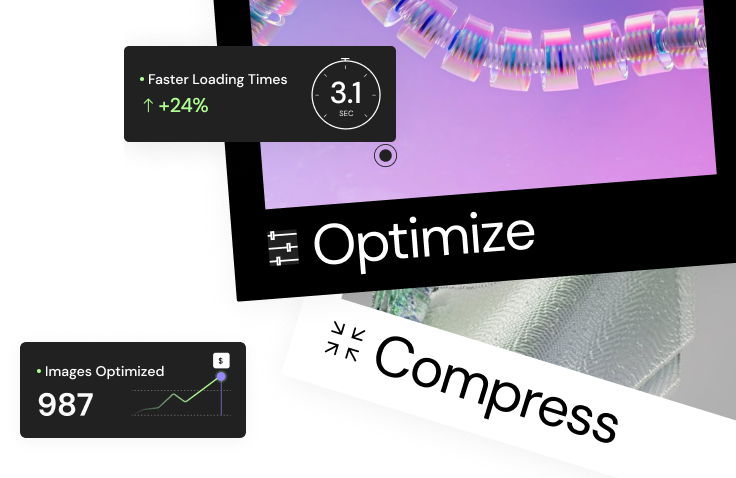
Compress them. Route assets through Image Optimization to strip metadata, convert to WebP, and skip uploading raw outputs to your site.
Are visual AI generators capable of designing functional website layouts?
They generate flat, static pictures, not functional HTML. Midjourney can help conceptualize a landing page, but you still need a developer to build it.
What’s the best prompt structure for generating web assets?
Specify subject, lighting, background color, and aspect ratio: “a sleek laptop on a solid #F4F4F4 background, soft studio lighting, isometric angle, 16 by 9.” A solid background makes CSS isolation easier.
Can AI safely generate accurate data charts or complex visual graphs?
No. Generative AI hallucinates raw data and struggles with precise alignment. Use dedicated charting libraries or native layout widgets instead.
Do I still need Photoshop if I subscribe to modern AI image generators?
Still worth keeping. Newer tools handle inpainting and text well, but you’ll need a standard editor for touch-ups or slicing images.
Why do my generated AI images look muddy when uploaded to WordPress?
WordPress compresses uploaded JPEGs to 82 percent quality by default, and that extra compression on AI artifacts makes images muddy. Upload WebP files instead.
Looking for fresh content?
By entering your email, you agree to receive Elementor emails, including marketing emails,
and agree to our Terms & Conditions and Privacy Policy.