Table of Contents
The web development industry is fracturing in 2026. Gartner predicts that by 2026, 80% of technology products will be built by people who aren’t traditional technology professionals. You’re seeing this reality play out right now. AI builders aren’t just generating boilerplate HTML anymore. They’re structuring entire web applications, configuring databases, and writing server-side logic on demand.
But the market is incredibly noisy. The global low-code development platform market is racing toward a massive $187 billion valuation by 2030. You don’t have time to test dozens of mediocre text-to-website generators. You need production-ready environments that output clean code, scale under traffic, and integrate directly with your existing infrastructure. Let’s break down the absolute best platforms available today based on actual technical merit, ease of use, and architectural flexibility.
Key Takeaways
- WordPress Dominance: Elementor powers over 13% of all websites globally, making its new agentic AI the most practical tool for existing site owners.
- Speed equals revenue: A mere 100-millisecond delay in website load time drops conversion rates by 7%. Modern AI tools must prioritize output performance.
- Non-tech adoption: With 80% of digital products soon to be built by non-developers, visual logic editors are replacing traditional IDEs.
- Enterprise scaling: Platforms like FlutterFlow have seen a 300% increase in enterprise users, proving visual AI code is now production-grade.
- Personalization matters: 72% of users demand personalized web experiences, a feature now easily automated by AI dynamic content blocks.
1. Angie by Elementor
Look, generic coding assistants are fine for basic scripts. But they don’t understand your specific content management system. Angie by Elementor fixes this completely. It’s a free, standalone agentic AI framework built specifically for WordPress. Instead of just spitting out raw PHP or JavaScript for you to copy and paste, Angie actually plans and executes tasks across your entire WordPress ecosystem.
It uses MCP (Model Context Protocol) to automatically inherit your site’s specific context. It knows your active plugins, your theme structure, and your custom post types. You ask for a custom Elementor pricing calculator widget, and Angie builds it, tests it in a safe sandbox, and pushes it to your live Elementor Editor Pro interface.
The true power of AI in web development isn’t generating raw code. It’s generating context-aware solutions that natively integrate with your existing CMS structure without breaking the site.
Itamar Haim, SEO Team Lead at Elementor. A digital strategist merging SEO, AEO/GEO, and web development.
Elementor currently powers over 21 million websites globally. By introducing an agentic AI that works smoothly within that massive ecosystem, they’ve created a massive shortcut for developers and agencies.
How Angie Executes Complex Tasks
- Context Gathering: Angie scans your WordPress environment using MCP to understand existing variables.
- Sandbox Generation: It writes and tests the custom code in a protected isolated layer.
- Native Asset Creation: It outputs native WordPress assets (like a custom post type or a front-end snippet) directly to your dashboard.
Key Features
- Agentic Framework: Takes action rather than just giving advice.
- Safe Experimentation: Fails safely in a sandbox before touching production.
- Full Creative Control: You review all generated code before approval.
- Ecosystem Integration: Works beautifully alongside Elementor ONE’s unified creation platform.
Pricing: Angie is a completely free WordPress plugin. Elementor ONE subscriptions start at $168/year for full platform access.
Pros
- Purpose-built for WordPress architecture.
- Reduces complex plugin development to natural language prompts.
- Doesn’t require an Elementor Pro license to function (though it pairs perfectly).
- Outputs clean, native WordPress assets.
Cons
- Requires an existing WordPress installation to operate.
- Heavy reliance on the quality of your initial prompt for complex logic.
Verdict: If you’re building on WordPress, Angie is the only logical choice. It understands your site’s DNA and turns hours of custom coding into a three-minute conversation.
2. Framer
Framer bridges the gap between a high-end design tool and an AI web app generator. You’ll immediately notice the interface feels exactly like Figma. But unlike Figma, Framer’s AI generates actual, production-ready code under the hood. You type a prompt, and Framer generates a localized, highly styled layout complete with complex CSS grid structures.
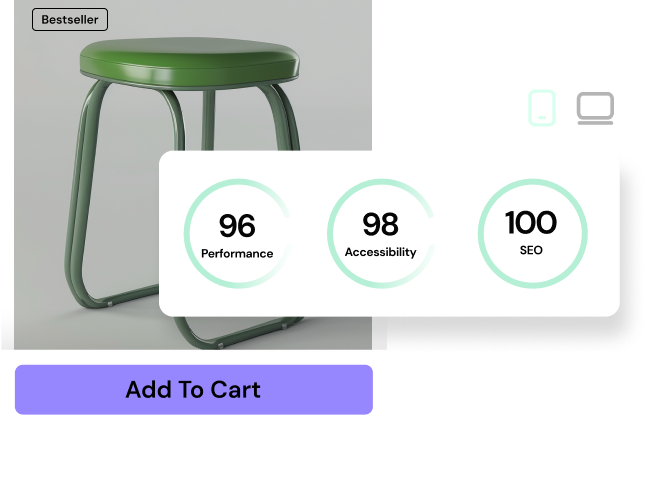
Performance is where Framer truly dominates. Framer sites consistently hit 90-100 scores on Google Lighthouse. They achieve this through a highly optimized proprietary layout engine and aggressive edge hosting. You don’t have to worry about minifying CSS or lazy-loading images. The platform handles all technical optimization automatically.
Key Features
- Text-to-Site Generation: Creates entire localized layouts from a single descriptive sentence.
- Advanced AI Animations: Generates complex scroll effects and spring animations without javascript plugins.
- Built-in CMS: Manage blog posts or portfolio items directly in the visual editor.
- Figma to HTML: Paste directly from Figma and let the AI convert vectors to web elements.
Pricing: Mini plan is competitive ratesnth. Basic is $15/month. Pro is $30/month for larger sites.
Pros
- Unmatched visual performance and frontend speed.
- The most intuitive animation timeline in the industry.
- Incredible template marketplace for quick starts.
Cons
- Weak backend capabilities compared to database-heavy builders.
- No code export option; you’re locked into their hosting.
Verdict: Choose Framer when visual impact is your absolute highest priority. It’s the best tool on the market for creative agencies, SaaS landing pages, and high-end portfolios.
3. Bubble
Bubble isn’t a simple website builder. It’s a visual programming environment for complex web applications. And with their recent AI integrations, the learning curve has finally flattened. Bubble has surpassed 3.3 million users and secured a massive $100M in Series A funding specifically to deepen their AI logic generation.
You can build a fully functional clone of Airbnb, Uber, or a custom internal CRM on Bubble. The AI API Connector is brilliant. It allows you to bind specific user inputs directly to large language models. You could build an app that takes a user’s uploaded PDF, sends it to Anthropic’s Claude to extract data, and saves that data into a specific relational database table-all without writing a single fetch request.
Key Features
- AI Database Schema Generation: Describe your app, and AI builds the relational data tables.
- Visual Logic Workflows: Create step-by-step server actions based on user triggers.
- Dynamic Data Binding: Connect frontend elements directly to backend database fields.
- Native API Integration: Connect to Stripe, SendGrid, or any REST API easily.
Pricing: Starter plan is $29/month. Growth plan hits $119/month for scaling businesses.
Pros
- True full-stack capabilities with complex user authentication.
- Massive scalability for millions of database rows.
- Strong community forum with thousands of pre-built plugins.
Cons
- The steepest learning curve on this list.
- Performance can lag if you design your database inefficiently.
Verdict: Bubble is the heavy-hitter for tech founders. If you need a complex SaaS MVP with custom user roles and heavy data processing, start here.
4. Webflow
Webflow has always been the darling of professional front-end developers. It forces you to understand the CSS box model. Now, Webflow uses AI to speed up the tedious parts of front-end structuring. It bridges the gap between rigid templates and raw code.
The AI handles CSS styling, suggests semantic class names, and helps structure logic flows for automated site actions. This is crucial for high-traffic environments. Webflow’s CMS plan runs $23/month, while their Business plan for high-traffic apps is $39/month. You’re paying for enterprise-grade security and ridiculously clean code output.
Key Features
- AI Class Naming: Automatically generates scalable, BEM-like CSS class names.
- Logic Flows: Visual automation for form routing and dynamic content updates.
- Code Export: Download your clean HTML, CSS, and JS files to host anywhere.
- Advanced Interactions: Build complex parallax and scroll-jacking effects visually.
Pricing: CMS is $23/month. Business is $39/month.
Pros
- Outputs the cleanest, most semantic code of any visual builder.
- Total granular control over every CSS property.
- Excellent for SEO due to semantic HTML5 structuring.
Cons
- You must understand CSS fundamentals to use it effectively.
- CMS limits can be restrictive for very large programmatic SEO sites.
Verdict: Webflow is for professionals who demand pixel-perfect precision and clean markup. It’s the agency standard for a reason.
5. Softr
If your business runs on spreadsheets, Softr is your best friend. It’s the fastest way to turn existing data into a secure, functional web app. Softr allows users to build apps directly on top of Airtable and Google Sheets. They currently support over 30+ data integrations and 100+ pre-built functional blocks.
The AI App Generator is remarkably straightforward. You write a prompt like, “Build an employee directory with a private login and a time-off request form.” Softr’s AI instantly configures the database schema in Airtable, builds the frontend user interface, and sets up the role-based viewing permissions. You literally launch in minutes.
Key Features
- AI App Generator: Full stack generation from a single text prompt.
- Role-Based Permissions: Control exactly which users see which database rows.
- One-Click Integrations: Connects directly to Zapier, Make, and Stripe.
- Pre-Built Logic Blocks: Use ready-made Kanban boards, calendars, and lists.
Pricing: Basic is $49/month. Professional scales to $139/month for massive datasets.
Pros
- Zero learning curve if you already know how to use a spreadsheet.
- Incredibly fast deployment for internal tools.
- User authentication is handled flawlessly out of the box.
Cons
- Design customization is highly restricted to block layouts.
- Not suitable for complex, bespoke consumer-facing applications.
Verdict: Softr owns the internal tool market. Use it for client portals, employee directories, and simple marketplaces.
6. FlutterFlow
FlutterFlow takes a completely different approach. It builds applications using Google’s Flutter framework. This means the app you build on the web can compile directly to native iOS and native Android code. It’s wildly popular in the corporate sector, reporting a 300% increase in enterprise users last year alone.
The AI Gen-Code feature is brilliant for custom logic. Let’s say you need a specific algorithm to calculate distance between two user locations. Instead of writing the Dart code manually, you describe the function to the AI. It writes the custom Dart code, tests it, and inserts it directly into your visual workflow.
Key Features
- Cross-Platform Output: Deploy to Web, iOS, and Android from one codebase.
- AI Gen-Code: Generates complex custom functions in Dart via text prompts.
- Native Backend Sync: Connects directly to Firebase and Supabase.
- State Management: Handles complex app states visually.
Pricing: Standard is $30/month. Pro is $70/month (which includes one-click APK downloads).
Pros
- True native performance on mobile devices.
- You own the code and can export it completely.
- Deep integration with Google’s backend infrastructure.
Cons
- Requires a solid understanding of application state and variable logic.
- The web output is canvas-based, which isn’t ideal for traditional SEO.
Verdict: FlutterFlow is strictly for app developers. If you need a web app that will eventually live in the App Store, this is your path.
7. Glide
Glide focuses heavily on mobile-first, data-driven applications. It shares similarities with Softr but heavily prioritizes field applications. Glide’s Pro plan costs $99/month, which gives you 5,000 specific data updates and 20GB of storage. That pricing makes sense when you see how much business utility it offers.
Glide AI is built directly into the data tables. You can set up a column that automatically runs sentiment analysis on customer feedback tickets. Or you can have the AI extract specific text from an uploaded image (like a receipt or a barcode) and populate your inventory database. It’s incredibly practical.
Key Features
- Glide AI Data Columns: Run AI operations automatically on new database entries.
- Adaptive Layouts: Interfaces automatically adjust for desktop, tablet, and mobile.
- Offline Mode: Certain app features work without an internet connection.
- Barcode/QR Scanning: Native hardware integration for mobile devices.
Pricing: Maker plan is $49/month. Team plan is $99/month.
Pros
- The most beautiful default UI for mobile data apps.
- Extremely fast to learn and deploy.
- Hardware integration makes it perfect for field teams.
Cons
- Pricing scales aggressively as your user base grows.
- Very limited design control; you must use their UI models.
Verdict: Glide is the absolute best choice for inventory management, field worker apps, and internal company operations.
8. 10Web
Site speed is a critical business metric. Remember, a 100-millisecond delay hurts conversions by 7%. 10Web solves this by using AI to build and optimize WordPress environments automatically. They guarantee a 90+ PageSpeed score by heavily optimizing the server stack and images automatically via Cloudflare Enterprise.
Their AI Website Recreator is wildly effective for migrations. You paste the URL of an old, slow website. The AI analyzes the layout, extracts the assets, and rebuilds an identical version inside a highly optimized Elementor environment. It saves agencies dozens of hours per client.
Top 3 Migration Steps Using 10Web
- URL Analysis: The AI scans the target site’s DOM structure and extracts all imagery.
- Element Recreation: It maps the old code to clean, responsive Elementor containers.
- Auto-Optimization: The platform applies aggressive caching, WebP conversion, and script deferral immediately.
Key Features
- AI Website Recreator: Clones existing site layouts instantly.
- Automated PageSpeed: Built-in optimization guarantees top tier performance.
- Managed Cloud Hosting: Dedicated Google Cloud infrastructure included.
- AI Content Assistant: Generates SEO-optimized copy natively in the editor.
Pricing: Plans start at an accessible $10/month.
Pros
- Takes the headache completely out of WordPress performance optimization.
- Incredible value since hosting is included.
- Makes migrating legacy sites incredibly fast.
Cons
- The AI recreation isn’t always 100% pixel-perfect on complex layouts.
- Lacks the deep agentic coding capabilities of Angie.
Verdict: 10Web is built for agencies that need to migrate and speed-optimize small business websites quickly and profitably.
9. Wix Studio
Wix Studio isn’t the consumer-grade Wix you remember from ten years ago. It’s a highly sophisticated, closed-ecosystem platform built specifically for design agencies. They’ve integrated AI deeply into the actual workflow of building responsive layouts.
Their AI Responsive Toggle is brilliant. Normally, you’ve to manually adjust padding, margins, and font sizes across desktop, tablet, and mobile breakpoints. Wix Studio’s AI analyzes the desktop layout and automatically adjusts the elements for all screen sizes with 85% accuracy. Their internal engineering data shows this reduces manual design time by 60%.
Key Features
- AI Responsive Design: Automates breakpoint adjustments instantly.
- AI Code Assistant: Helps write custom Velo (Wix’s Javascript framework) logic.
- Client Handover Tools: Built-in dashboards for client billing and analytics.
- Native SEO Suite: Strong, automated technical SEO tools integrated directly.
Pricing: Professional agency plans start at $19/month.
Pros
- The responsive AI tool genuinely saves hours of tedious work.
- Incredible all-in-one ecosystem for managing client retainers.
- Very smooth, absolute-positioning design interface.
Cons
- Totally closed ecosystem. You can’t export your site or host it elsewhere.
- Velo Javascript can be restrictive compared to open-source frameworks.
Verdict: Wix Studio is a powerhouse for freelance designers who want to offer web design, hosting, and marketing as a single package without touching servers.
10. Dora AI
Dora AI represents the absolute bleeding edge of visual web generation. Traditional web design is flat. Dora focuses heavily on 3D, spatial web experiences. They claim their text-to-3D site generation represents a 400% increase in design complexity compared to traditional 2D builders.
You can prompt the AI to build a landing page featuring a 3D rotating product model. As the user scrolls, the camera angle changes, text fades in, and lighting adjusts. It achieves this without requiring you to manually plot complex keyframes or write custom WebGL shaders. Furthermore, with 72% of users preferring personalized experiences, Dora allows you to dynamically alter these 3D scenes based on user interaction.
Key Features
- Text-to-3D Generation: Creates immersive web scenes from simple text prompts.
- Keyframe-Free Animation: AI handles the complex scroll-timing logic automatically.
- Advanced WebGL Integration: Runs high-fidelity 3D models smoothly in the browser.
- Spatial Layouts: Breaks free from standard box-model design constraints.
Pricing: Currently in late beta, pro features are estimated around $20/month.
Pros
- Produces visually stunning, award-winning style websites.
- Eliminates the need for a dedicated 3D web developer.
- Highly engaging output that dramatically increases time-on-site.
Cons
- Still lacks deep, functional backend database integrations.
- 3D assets can cause performance issues on older mobile devices.
Verdict: Dora AI is for high-end consumer brands, creative agencies, and portfolios that need to drop jaws and win design awards.
Comparison Summary Table
Need a quick breakdown? Here’s how the top contenders stack up across core technical requirements.
| Platform | Primary Strength | Best For | Starting Price |
|---|---|---|---|
| Angie by Elementor | Contextual Agentic AI | WordPress Users & Agencies | Free (Plugin) |
| Bubble | Complex Logic & Databases | SaaS Founders | $29 / mo |
| Framer | Visual Speed & Animation | Designers & Portfolios | $5 / mo |
| Webflow | Semantic Code Output | Professional Developers | $23 / mo |
| Softr | Data to UI Generation | Internal Business Tools | $49 / mo |
| FlutterFlow | Cross-Platform Native Code | Mobile App Developers | $30 / mo |
Final Recommendation: Which AI Web App Builder Should You Choose?
You can’t just pick the tool with the flashiest marketing. Your choice completely depends on your existing infrastructure and business goals. If you choose wrong, you’ll hit a technical wall three months into development.
- For WordPress Environments: You absolutely must use Angie by Elementor. It’s the only agentic AI that natively understands WordPress context, reads your existing plugins, and outputs safe, functional code directly into your dashboard.
- For Complex SaaS Products: Choose Bubble. The learning curve is steep, but the visual logic tree and AI API connector let you build massive, scalable applications without writing server code.
- For Visual Impact & Portfolios: Go with Framer. The text-to-layout generation is flawless, and hitting 90+ on Lighthouse out of the box saves you endless optimization headaches.
Frequently Asked Questions
Can AI web app builders replace traditional developers?
Not entirely. AI builders handle 80% of the repetitive structural work, like setting up database schemas and writing basic CRUD operations. However, you’ll still need human oversight for highly complex, bespoke security logic and unique API integrations.
Does code generated by AI impact SEO negatively?
It depends on the platform. Tools like Webflow and Elementor output semantic HTML5 and clean CSS, which search engines love. Canvas-based builders (like early Flutter web outputs) struggle with SEO because crawlers can’t easily read the visual elements.
What is MCP and why does Angie use it?
MCP stands for Model Context Protocol. It allows the AI to securely read your specific local environment. That’s why Angie doesn’t just guess code; it writes code specifically tailored to the plugins and themes currently active on your WordPress site.
Can I export my code from these AI builders?
Only some of them. Webflow and FlutterFlow allow full code export, giving you total ownership. Platforms like Bubble and Wix Studio are closed ecosystems. You must host your application on their servers.
Are no-code AI apps secure?
Yes, major platforms handle security at the server level. Bubble, for instance, uses strict database privacy rules that prevent unauthorized data access. Just ensure you configure your role-based permissions correctly.
How much do these platforms actually cost at scale?
While starting prices are low, costs scale with traffic and data. A high-traffic Webflow site runs $39/month. A complex Bubble app can easily cost over $119/month once database rows increase. Always check the scaling tiers before committing.
What is the fastest way to build an internal company tool?
Softr or Glide are your best options. If your data already lives in Airtable or Google Sheets, Softr’s AI can generate a secure, functional front-end interface in under ten minutes. It completely removes the friction of building employee portals.
Looking for fresh content?
By entering your email, you agree to receive Elementor emails, including marketing emails,
and agree to our Terms & Conditions and Privacy Policy.